

Atari ST - 1995
ESS-Code
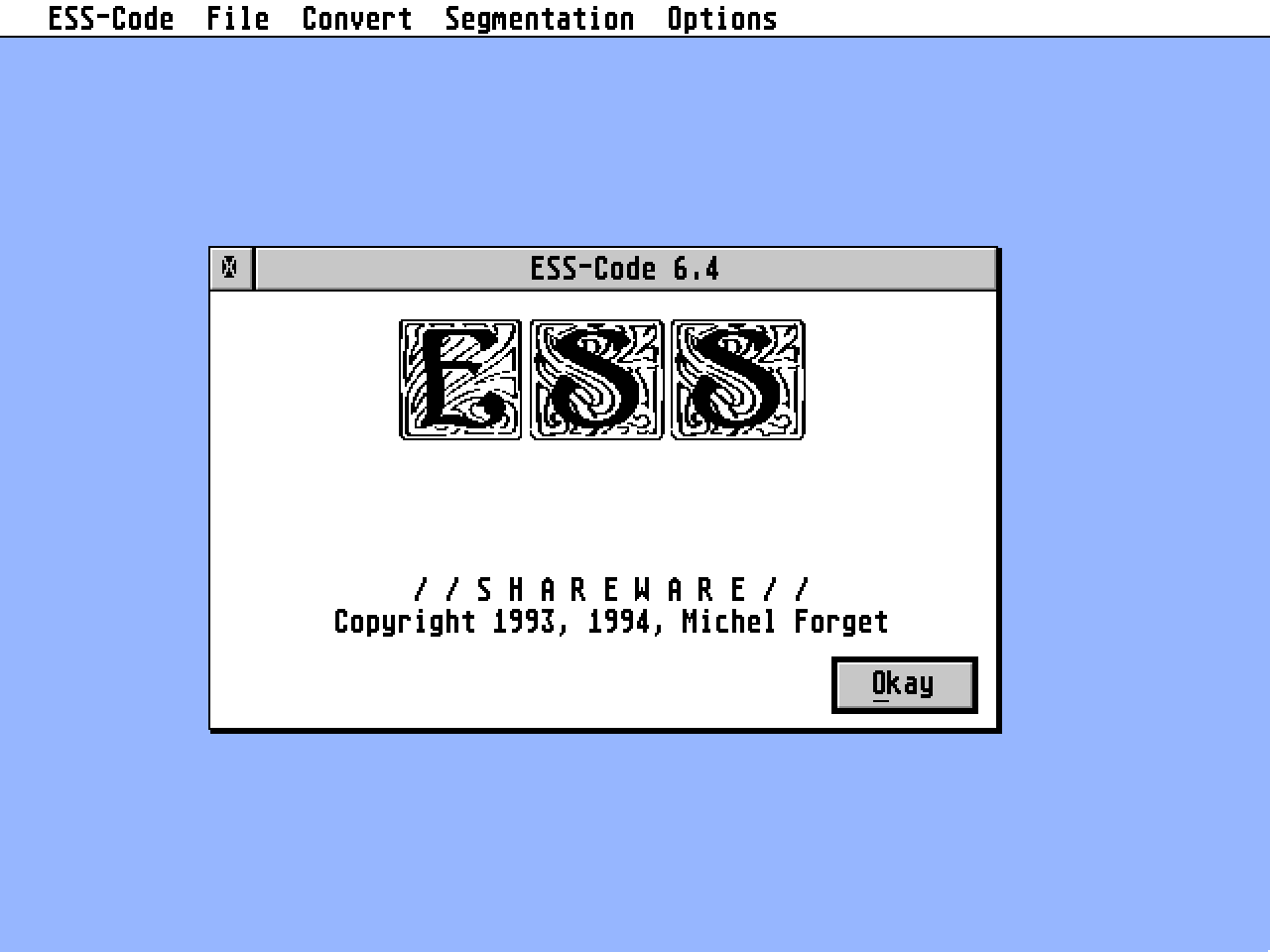
- Genre
- Communications / Radio / Electronics
- Year
- 1995
- Language
- [unknown]
- Publisher
- [no publisher]
- Controls
- Keyboard / Mouse
- Distributor
- —
- Resolution
- Medium / High / VGA
- Developer
- Electric Storm Software
- ST Type
- ST, STe, TT, Falcon030 / 0.5MB
- Licensed from
- —
- Programmer(s)
- Forget, Michel
- Country

- MIDI
- —
- Software
- English
- Version
- 6.4
- Box/Instructions
- English
- Number of Disks
- 1 / Double Sided
- License
- PD / Freeware / Shareware
- Dump
- Download
- Serial
- —
- Dump format
- MSA
- Protection
- —
OTHER VERSIONS WITH THE SAME TITLE (1)
INSTRUCTIONS
ESS-Code 6.4:  N E W  F E A T U R E S  &  B U G  F I X E S
-=-=-=-=-=-=-=-=-=-=-=-=-=-=-=-=-=-=-=-=-=-=-=-=-=-=-=-=-=

Please note that this list of new features and bug fixes is in
chronological order; new information will appear at the end of the
list.

[ESS-Code 6.0:  June 16, 1994]

                * * * I M P O R T A N T   N O T I C E ! * * *

     As a direct result of the growing investment of time and effort
     placed into this application, ESS-Code is now a SHAREWARE product.

     Users who register ESS-Code will receive a disk with the latest
     version of ESS-Code (optimized), and a registered (optimized,
     personalized) version of MasterBrowse (which also includes MasterPrint,
     AutoDate, ACC-Pad, ShadowTerm II, and a coupon for a free catalog from
     Suzy B's Software and a $3 credit toward the purchase of a disk from
     the Suzy B's Software collection).

     The continued development of ESS-Code depends _solely_ on user
     contributions; if no such contributions are received, this
     application will not be developed further.

     For more information on registration, please read the "Registration"
     section of this manual.

                * * * * * * * * * * * * * * * * * * * * * * *

NEW FEATURE:  ESS-Code now supports MIME-Encoding/MIME-Decoding.  The
              MIME conversion method is rapidly replacing all other
              conversion methods; it is not as fast as some, but it
              generates very compact output and is extremely
              reliable.  The MIME conversion method is supported on the
              UNIX, Amiga, Macintosh, IBM, and Atari computer
              platforms.

NEW FEATURE:  ESS-Code now has an expanded command line interface; the
              previous command line interface is still present (for use
              as an installed application).  The new method consists of
              eight possible commands; the commands are not case
              sensitive, but the commands and arguments must appear in
              exactly the order shown below:

                   -uue     [source] [destination file]
                   -uud     [source] [destination file]
                   -btoa    [source] [destination file]
                   -atob    [source] [destination file]
                   -ship    [source] [destination path]
                   -unship  [destination file] [source] [...]
                   -mime    [source] [destination file]
                   -unmime  [source] [destination file]

NEW FEATURE:  The entire ESS-Code manual is now available at any time
              from within ESS-Code (if the ST-Guide accessory is
              installed).  By making the online help external, the
              overall program size is reduced and the quality of the
              online help is vastly improved.  If you want to move the
              "ESSCODE.HYP" file out of the ESS-Code directory, you
              must define the "ESSHELP" environment variable; it should
              contain the full pathname of "ESSCODE.HYP".

              ST-Guide is available on many FTP sites, commercial services,
              and public access bulletin board systems.  If requested,
              a copy of the ST-Guide archive can be placed on the disk
              sent to registered users.

[ESS-Code 6.1:  June 29, 1994]

NEW FEATURE:  ESS-Code can now handle MIME-Encode/MIME-Decode requests
              from the operating system, or when ESS-Code is called as
              an installed application.  Valid extensions for a
              MIME-Encoded file are ".M", ".MIM", & ".MIME" (case
              sensitive).

[ESS-Code 6.2:  October 6, 1994]

    BUG FIX:  ESS-Code will now work with the Falcon (in any resolution)!
              The solution to this problem was presented by Christian
              Grunenberg, the author of EnhancedGEM (the GEM library
              that ESS-Code uses).

    BUG FIX:  ESS-Code will now move files to the proper destination
              location if SHIP-Encoding is used.

[ESS-Code 6.3:  November 11, 1994] / Atari Version

NEW FEATURE:  At the request of several users, ESS-Code has been modified
              to conform to the emerging standard followed by GEM
              archive utilities.  If it is executed directly, or
              executed by the desktop as an installed applications, the
              GEM-Interface will be utilized.  If ESS-Code is invoked
              as a TOS program (.TTP) or given arguments for the CLI
              interface (-uue, -uud, -ship, -unship, -btoa, -atob, -mime,
              or -unmime) then a TOS-Interface will be utilized.  The
              TOS interface is not as powerful as the GEM-Interface, by
              any stretch of the imagination, but it allows ESS-Code to
              be called by archive shells where it previously could not
              be.

    BUG FIX:  ESS-Code will no longer explicitly state the path of the
              ESSCODE.HYP file -- instead, it will merely pass the name
              of the file and allow ST-Guide to locate it.  If you do not
              want this to happen, create an environment variabled called
              "ESSHELP" and set it to the complete path of the ESSCODE.HYP
              file.

NEW FEATURE:  There are now three menu options in the "File" menu that
              communicate with ST-Guide.  "Introduction" will display
              the introduction section of the manual.  "Contents" will
              display the table of contents of the manual.  "Index"
              will display the index of the manual.

 ALTERATION:  The "ESS_DPATH" environment variable has been changed to
              "ESS_DEFAULT_PATH".

[ESS-Code 6.4:  June 9, 1995]

==IMPORTANT NOTE=============================================================

     It has been nearly seven months since the previous release of ESS-Code.
There are several reasons for the lengthy delay:

       1) I attend college now, and time is hard to find (even for something
          I love as much as programming).

       2) I have been spending my free time writing the PC version of
          ESS-Code.  It is done now, and has been released.  For those
          who are interested, it is available at:

          SimTel/win3/encode/ecd64awn.zip (Windows)
          SimTel/msdos/decode/ecd64dos.zip (DOS)

     I want to stress, however, that I will be updating the Atari version of
ESS-Code regularly, exactly as I have in the past.  This version of ESS-Code
incorporates many new features and fixes some major bugs.  There has been
some speculation that I have stopped supporting the Atari (presumably because
of my long absence) -- that is definitely, absolutely, incorrect.  I will
continue to support the Atari for a long time to come.

     One final note that I would like to make is that the Atari version
of ESS-Code and the PC version of ESS-Code are 100% compatible.  I mention
this because until now the PC market has had very little in the way of
standard, UNIX compatible, file conversion utilities.  You should now be
able to send files to your friends with PC systems much more easily.

=============================================================================

    BUG FIX:  When decoding multipart MIME-Encoded data, ESS-Code
              will no longer become confused or generate false output
              files.

    BUG FIX:  When decoding MIME-Encoded data, ESS-Code will now show
              the name of the current input file being processed
              instead of the name of the current (temporary) output
              file being generated.

NEW FEATURE:  ESS-Code now has an option to allow you to included a
              character table in UUEncoded output.  This was always
              done in the previous version, but now it is an option.

NEW FEATURE:  A "Quick Find" feature has been implemented in ESS-Code.
              This makes it possible for you to select the first
              segment of a multipart MIME-Encoded message or a
              multipart SHIP-Encoded message and then allow ESS-Code
              to automatically locate the remaining segments.

NEW FEATURE:  The "RAW Split" & "RAW-Concatenate" features have been
              replaced with a new set of functions that will allow you
              to split/join binary files as well as ASCII files.

NEW FEATURE:  In TOS mode, ESS-Code will now allow you to respond
              to "Yes/No" questions with a Y/N.  You can still use
              the 1/2 method, if you prefer.

NEW FEATURE:  Do you receive encoded files in electronic mail, or download
              encoded files from USENET newsgroups?  If so, you are very
              likely aquainted with the frustrating process of building a
              single file from the multiple messages.  This must be done
              because the encoded files are rarely segmented using a
              standard method.  ESS-Code now has the ability to create a
              single non-segmented file from a series of non-standard
              segmented files based on a template of your choosing.  This
              vastly reduces the amount of time required to convert files.
              There are twelve templates supplied with ESS-Code; if none of
              them meets your needs, you can create your own using the
              following format:

              Example:
              --------

              [ESS-Code Filter]
              USENET Newsgroup Format #1
              BEGIN--cut
              END--cut
              1
              1

              The first line ("[ESS-Code Filter]") is used to determine
              that the file is, in fact, a filter.  The next line is the
              name of the filter (a description).  The third line is the
              "start of data identifier".  It must be a unique series of
              characters that appears immediately before the encoded data.
              The fourth line is the "end of data identifier".  It must be
              a unique set of characters that appears immediately after the
              last line of encoded data in the segment being processed.
              The next line is the "start identifier count".  This will
              usually be set to one, which will cause ESS-Code to accept
              the first instance of the start of data identifier.  It can
              be set to another value if the file format is exceptionally
              strange and requires it.  The last line is the same as the
              line discussed above, but corresponds to the "end of data
              identifier".

              You can use any ASCII text editor to create a filter, but
              please be aware that filters _ARE_ case sensetive.

 ALTERATION:  The messages shown in file selector boxes have been changed
              so that they are (with any luck) less confusing.  If you are
              ever in doubt, consult the manual.

                                                   -Michel Forget
                                                    Electric Storm Software
                                                    June 9, 1995