

Atari ST - ?
Who Stole the Peanut Butter?
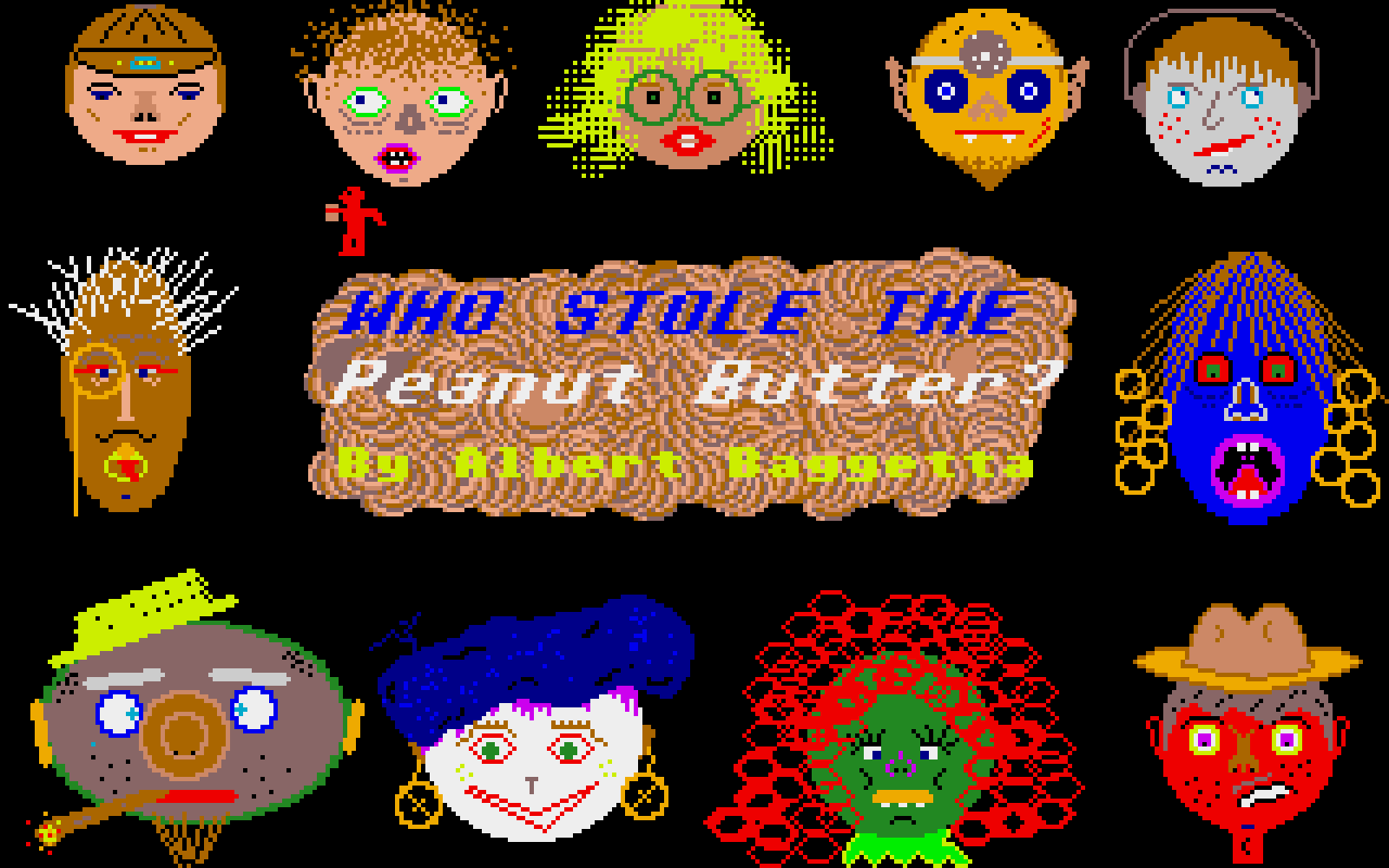
- Genre
- Strategy - Detective
- Year
- —
- Language
- GFA BASIC
- Publisher
- [no publisher]
- Controls
- Keyboard
- Distributor
- —
- Players
- 1
- Developer
- [n/a]
- Resolution
- Low
- Licensed from
- —
- Programmer(s)
- Baggetta, Albert
- Country

- Graphic Artist(s)
- Baggetta, Albert
- Software
- English
- Game design
- Baggetta, Albert
- Box/Instructions
- English
- Musician(s)
- [n/a]
- License
- PD / Freeware / Shareware
- Sound FX
- [unknown]
- Serial
- —
- Cover Artist(s)
- —
- ST Type
- ST, STe, Falcon030 / 0.5MB
- MIDI
- —
- Version
- —
- Dump
- Download
- Number of Disks
- 1 / Double Sided
- Dump format
- MSA
- Protection
- —
INSTRUCTIONS
Albert Baggetta
P.O. Box 351
Feeding Hills, MA  01030-0351

~~~~~~~~~~~~~~~~~~~~~~~~~~~~~~~~~~
      Baggetta  Shareware

If you obtain a copy of this program
please send $3 to the above address.
Registration will entitle you to:

-- Update information
-- Information about other Shareware
   products
-- Claim that you are supporting
   Atari developers
-- A clear conscience
~~~~~~~~~~~~~~~~~~~~~~~~~~~~~~~~~~~
~~~~~~~~~~~~~~~~~~~~~~~~~~~~~~~~~~~


            Who Stole the Peanut Butter?

                By Albert Baggetta


      It never fails.  Seems like every time you go to make
a peanut butter sandwich the peanut butter is gone.  Oh,
the jar might be there, but it's usually empty.  The walls
are scrapped clean with maybe a little swirling kiss of
peanut butter left in the bottom center of the jar.  It
almost seems as though there is some little PB gremlin that
hides in the cabinet.  Put a new jar back, and next time it
is gone.
      This gave me an idea for a great-peanut-butter-mystery
for the Atari ST, "Who Stole the Peanut Butter?"  This
diversion "puts the blame" on one of eleven fugitives from
the Most Wanted list of peanut butter criminals.  Here is a
brief description of each of these potential culprits:


Roller -- Don't let this cute face fool you.  He has
          a nutty record that is veiled by his boyish
          look.

Zipper -- This rather weird creature looks like your
          typical deranged individual that would
          indulge in peanut theft.  So right you are.
          Next to Roller, he holds the record for
          the most peanut butter jars stolen in one
          week.

Clio   -- Clio is a fetching, little blond whose
          passion for peanuts far exceeds that of all
          the starving elephants in the circus world.

Viper  -- This bandit escaped from a laboratory where
          the government was performing experiments
          on the benefits of peanut oil on the eyelids
          of humans.  The tests not only marred his
          vision but snapped his mind so that he feels
          he must remove all peanut butter from
          circulation.

Wave   -- He got his name because he is always
          listening to the radio waves.  His favorite
          commerials?  You guessed it -- peanut
          butter jingles.  Not much is known about him
          and why he has such a passion for the nutty
          paste.

Coco   -- This frightning creature took first place in
          a contest that mixed peanut butter with
          liver.  Unfortunately the success went
          to her head, and she has been ever since
          looking for more peanut butter to create
          more fascinating recipes.

Tex   -- This peanut butter thief comes from Texas.
         As a boy he was taught that Texans have the
         biggest and most of everything.  So he
         decided to accumulate the biggest stash of
         peanut butter around.  It is believed that
         he stores it all under Guadalupe Peak.

Lime   -- This crazy girl becomes "green" with envy
          every time she sees someone with a jar of
          peanut butter.  If she is in the same room,
          don't turn your back on her (or at least
          keep a good grip on your peanut butter jar.)


FeeFee -- Acting sultry and diminutive, this
          lady is known in peanut crime as the French
          Confection, since she uses her stash of
          peanut butter to make peanut-flavored candy.
          Most of her creations end up on the foreign
          market.

Uncle  -- This likable "gentleman" is an old-timer
          when it comes to sneaking peanut butter.
          He sort of fancies himself a "Robin Hood" of
          the geriatric peanut butter world, since all
          of his thefts are distributed amongst the
          over-sixty generation.

Professor -- This is the English Godfather of the peanut
             underworld.  His erudite and refined manner
             beguiles the unsuspecting owner of peanut
             butter into thinking that this substance is
             no good for one's health.  After a thorough
             brain washing by this clandestine fiend,
             people have been known to abandon all their
             peanut butter for litchi nuts and barley
             seeds.

      So there you have it, the notorious peanut butter
felons that inhabit the game of "Who Stole the Peanut
Butter?"

Object and Rewards of the Game

      In each round of the game your objective is to
discover the peanut butter thief, selecting from the array
of unsavory individuals listed above.  If you are feeling
lucky you might take a wild guess, but it is probably more
sensible to look for evidence, first.


      If you are successful, you will receive ample reward
for your accomplishments, but, as is often the case in the
real world of crime, the thief will get off with a slap on
the hand and will be back in circulation within a short
time.  Like many law enforcement officials in the real
world, you begin to feel the magnitude and frustration of
stopping crime.

Game Play

      "Who Stole the Peanut Butter?" is a compiled, GFA, low
resolution game.  Your disk should contain the following
files:


      PEANUT.PRG   -- The main program file
      HEAD_2.PI1   -- Graphic screen #1
      NOTES.PI1    -- Graphic screen #2

      If any of these files is missing, the program will not
run properly.
      Boot up the main program.  The title screen will load
from the disk, and you will see a silhouette of the thief
scamper across the screen.  Don't bother to try and
identify the guilty party, the movement is too fast.
      For users interested in GFA, I want to mention that
the silhouette is actually three sprites, created with a
sprite editor called Sprite & Mouse Editor, by MichTron.
Moving these sprites alternately across the screen creates
a brief but amusing animation.  It should also be noted
that the title screen is not merely cosmetic to this
program.  While the screen is displayed, the program is
utilizing the GET command to take invisible "snapshots" of
each of the heads.  These will be used later in the
program.  It only takes a second for the computer to store
these images (whew!! what speed), so a pause has been
installed to allow you to read the title screen.
      The next screen that loads is the work area.  On first
booting this game, the screen loads slowly from a floppy
disk (increased speed is noticed with a hard drive).
Subsequent rounds that use this screen do not load it from
the drive, so it will appear more quickly.  The screen is
divided into three areas with assorted information, so I
will discuss each of these separately.
      The bottom half of the screen is the general input and
message area.  A chunk of this area is reserved for
messages to the player, and the window is used for player
inquisition.  More about this later.
      There is a framework in the upper half of the screen
where assorted actions are performed.  The left side of
this area is called the MUG SHOTS file.  The right side is
the FACTS-ON-FILE notebook where your discoveries about the
fugitive are written.  Part of this display shows a
container of the ever-popular peanut butter (no brand names, please).
      Upon first entering the work area, you are presented
with one of 11 points of identification:


1. Head Shape        (shape)
2. Eyes              (color, shape)
3. Mouth             (shape, color, other)
4. Nose              (shape, color, size, other)
5. Ears              (shape, size, other)
6. Adornments        (articles - worn, used, etc.)
7. Eyebrows          (shape, color)
8. Expression        (look on face)
9. Face Features     (chin, dimples, etc.)
10. Face Color       (assorted)
11. Hair             (type, color, etc.)

      These will be offered after every response until all
of them have been used up, or until you correctly guess the
thief's name.
      For example, you might see the prompt: "You may guess
the culprit's eyes."  These will appear in random order, so
you will not always get the same prompt.  Also, you will
only get one guess at the prompt, until it is offered again
(unless the program randomly selects it again,
i mmediately).
      If you make a mistake while typing the response, you
can easily change it by using the  key to erase
all or part of your entry.
      Along with the prompt, you will be given a hint at
possible answers.  These can be helpful at times, but since
all possibilities are not given, it will take some
experimentation to achieve results.  In a sense, this works
somewhat in the manner of an adventure game.  You just keep
entering possible words or phrases until something works.
      If you match a characteristic of the peanut butter
thief, the attribute will be entered in the FACTS-ON-FILE
window, so that you may refer to this when making a
conviction.  You may then search for more clues.
      If you do not make a match, another prompt will be
displayed, and you may guess again.  But a wrong guess will
cost you time points.  Notice the meter just below the
FACTS window.  This will display a numeric account of your
time left.  It starts at 100 and is decremented every time
you make a wrong guess.  When this reaches point zero, you
will be forced to identify the thief by name, even if you
haven't the slightest idea.
      It is best, of course, to try and garner enough
information about the culprit so that you can make an
intelligent accusation, before the number of points is
depleted.
      How much is decremented and the amount of the
potential reward for a criminal's capture is determined by
the round you are in.  Basically there are five rounds in a
game segment, and the breakdown of ROUND, DECREMENTS,
REWARDS, and CHANCES are listed in the chart below.  The
decrements, called offsets in the program, are shown above
the prompt window so that you can quickly identify which
round you are in.

	___________________________________________________
	|         |              |              |         |
	|  ROUND  |   DECREMENT  |    REWARD    | CHANCES |
	|=================================================|
	|    1   	|      10      | $10 - $20,000|    10   |
	|---------|--------------|--------------|---------|
	|    2    |      15      | $10 - $25,000|     7   |
	|---------|--------------|--------------|---------|
	|    3    |      20      | $10 - $30,000|     5   |
	|---------|--------------|--------------|---------|
	|    4    |      25      | $10 - $35,000|     4   |
	|---------|--------------|--------------|---------|
	|    5    |      50      | $10 - $60,000|     2   |
	|-------------------------------------------------|
	|          Round 5 is the restart round           |
	|_________________________________________________|


      Notice that in order to get the greatest rewards on a
correct accusation, it is best to work toward the last
round, although there is still no guarantee you will get
the maximum amount.  Also, there is a way to start over at
an easier round, if you have fears of losing too many time
points.  At the prompt, during ROUND 5, type 'restart' and
press .  You will notice the offset number change
to 10, indicating you are now working in a round 1 level.
      Oh...did I forget to mention that the thief has an eye
on you at all times and is not a very good sport?  Every
once in a while the little devil will scurry out from the
left side of the screen and steal a chunk of your time
points, forcing your hand.

      Whether or not you are successful guessing the
culprit's name, you will be taken to a "rap sheet," which
reveals information about the thief.  If you are successful
with your identification, you will see a stamp on the
folder that indicates that the culprit has been CAPTURED.
If not, you will see a large WANTED emblem, indicating that
the thief is still at large.  The "rap sheet" also gives
some other amusing but irrelevant information like aliases,
weight and age.
      If you capture a thief, you will be rewarded
handsomely with the current prize.  These rewards will be
accumulated throughout the game until a cache of $200,000
has been achieved.  At this point the game will clear, and
the weary bounty hunter may work on a new fortune.
      Your wealth is continually displayed on the work area
screen, but if you would like to know exactly how many
culprits you have apprehended in a game and how much each
has contributed to your financial well-being, you can type
'bank' at the prompt and press .  This will take
you to your 'bank book', where you can examine all of the
above information.  Press  again, and you can
resume the game.  This action may be performed at any
identification prompt.


Game Help

      By storing characteristics in the FACTS-ON-FILE
window, you can easily keep track of the features you have
discovered.  But the game also has a built-in mug file,
just like those used by real law enforcement agencies, that
allows the user to flip through a series of pictures of the
likely peanut villains.  Viewing this line-up sometimes
makes it much easier to match the features you are seeking.
      For example, if you have already found that the
culprit has wiry hair, brown eyes and a wide mouth, you can
search the mug shots to narrow down the characters that
possess these features.
      To search the mug file, type 'mug' at a prompt.  The
response window will clear, replaced with a new set of
options.  A mouse cursor will appear on screen, and the MUG
SHOTS window, which displayed the Most Wanted list of
names, will now show the first mug shot in the file.  The
names of these characters will appear in the SUSPECT area,
under the FACTS window.  Click on the blue bar under the
MUG SHOTS window to flip through this file.  You may also
use the  key to move from one picture to the next.
      This file is most useful in two ways.  Flip through
the file to look for a characteristic you were just
prompted for, or glean them for features in the FACTS file.
Careful observation, good guessing and judicious use of the
MUG SHOTS can lead to a quick discovery of the culprit
      From the MUG SHOTS window there are always two
possible exits, depending on whether you want to continue
with the game or end the round.  If you want to return to
the last prompt, simply click on the RIGHT mouse button.
The MUG SHOTS window will once again show the wanted list,
and the last cue will be restored, waiting for your
response.
      There is one catch here.  You may only dip into the
mug shot file once in each round (we don't want to make the
game too easy).  A second time in a round, you will only
have access to the accusation bar.  Of course, you may
change your mind and return to the game by pressing the
right mouse button, instead.
       If you think you have discovered the thief and are
ready to make an allegation with the accumulated facts,
move the mouse pointer to the bar under the FACTS-ON-FILE
window.  It shows the game label, "Who stole the peanut
butter?"  Click on this, and you will be given a signal to
guess the thief.  Type in the name of the thief and press
 to find out if you are correct.  After viewing the
"rap sheet", press  again, and the game will
recommence with you in pursuit of a new crook.

      If you get tired of accumulating fortunes, outwitting
peanut butter thieves, or simply want to quit the game,
type 'exit' at a prompt, and press .  The game will
end, and you will return to the desktop, confident that if
your peanut butter is ever missing, you might have an idea
of who is to blame.