

Atari ST - Cali-Co Superior Software - 1992
Mah-Jong Solitaire
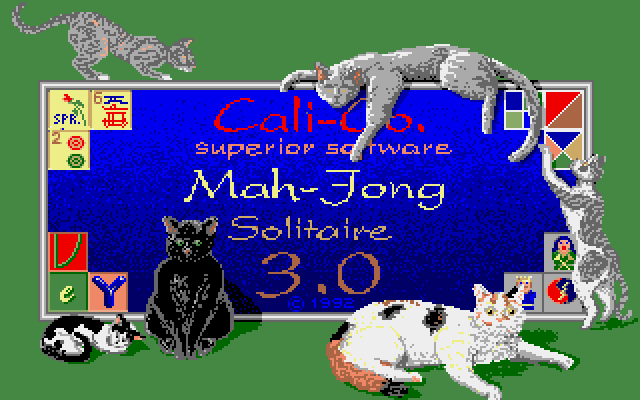
- Genre
- Brain - Shanghai / Mah Jong
- Year
- 1992
- Language
- GFA BASIC
- Publisher
- Cali-Co Superior Software
- Controls
- Mouse
- Distributor
- —
- Players
- 1 / Demo
- Developer
- [n/a]
- Resolution
- Low
- Licensed from
- —
- Programmer(s)
- Snyder, Josh
- Country

- Graphic Artist(s)
- Snyder, Fiona / Snyder, JoshRena
- Software
- English
- Game design
- Rena / Snyder, JoshSnyder, Fiona
- Box/Instructions
- English
- Musician(s)
- [n/a]
- License
- Commercial
- Sound FX
- [unknown]
- Serial
- —
- Cover Artist(s)
- —
- ST Type
- ST, STe, TT / 0.5MB
- MIDI
- —
- Version
- 3.02
- Dump
- Download
- Number of Disks
- 1 / Double Sided
- Dump format
- ST
- Protection
- —
OTHER VERSIONS WITH THE SAME TITLE (2)
ADDITIONAL COMMENTS
Huge thanks to Bob C for finding and archiving this long lost title!
INSTRUCTIONS
Mah Jong 3.0
Help
Normal

*  HISTORY

    Mah-Jong  solitaire is based on an ancient tile game, originally
played exclusively by the ruling Manderin class in China.  It has been
traced as far back as the time of Confucious (480 BC or thereabouts).


   When China became a Republic in 1911, the game became available to all
classes and, as Ma Cheuck, gained instant popularity throughout the
Orient.  The rules of the game played in North China differed somewhat
from those used in South China, and there tended to be local variations.


   In 1920, a version of the game which combined features of both major
systems was introduced in the USA and Europe.  The game became widespread
instantly.  Although the game rules were overly complicated at first, they
were soon regularized by the National Mah Jongg League, Inc., and the game
has maintained an enthusiastic following ever since.


   When we at  Cali-Co  decided that we wanted to make this solitaire
game, our friend  Halati   brought his Mah Jong set along when he
came for a weekend.  We laid his set out on the living room floor and took
a snap-shot!  That photograph was the basis for our first (The
Traditional) tile set.  Since then, we have seen many other physical Mah
Jong sets, from an old processed amber set to a cardboard beginner's set.


   Our version of  Mah-Jong  has gone through  MANY  incarnations over
the years, and now sits as a  TOTALLY NEW  version, written (again)
completely from scratch.  It has taken over a year to write, and we hope
that you like it.

*  OBJECT OF THE GAME


   The object of the game is to  WIN  by removing all of the tiles from
the board.  This is done by removing two paired tiles at a time.

*  RULES (REMOVING TILES)

   Tiles are removed by clicking on one tile, then clicking on a second
tile that matches the first one.  Each of these tiles MUST be "free"
before you click on either of them.


    ( A  "free"  tile that has been selected turns a different
 color  and the edges  "Flash"  to let you know that you have selected
it.  If the tile you selected does not  "Flash" , it is not  "free" ,
and is therefore   NOT   selected.  This flashing is handy in some
tile sets like  Flag .)


   Tiles may ONLY be removed horizontally.  Any tile on a row MAY be
available IF there is no tile  on the same level  to the right OR to the
left.  Any tile which has another tile on top of it is not free.  (For
instance, in the Mah Jong layout, the center tile in a new layout covers
the four tiles under it, and they are not available.)


   What are matching tiles?  For the most part, tile sets are made up of
groups of four identical tiles which match each other.


   There are variations, though.  The Mah Jong set contains 4 flowers and
4 seasons.  Each of these tiles is different, but they match the others in
their group.  Similarly, the Pensic People tile set has 4 shields with
white backgrounds and 4 shields with color backgrounds, each tile
different, each matching the others in their group.  The Rune Blocks tile
set has 6 identical tiles in each group, i.e. 3 pairs of each.  This makes
it easier to win a game.

*  SCORING

   A  High Score  is attained by a combination of winning a game and
speed of play.  If you win a game, you are able to enter your name on the
 High Score List .  Your placing on that list is ranked by the time it
took to complete the game.  If you have used the  Show Removed  or
 Undo  features, your time will be  increased  by a predetermined
number of seconds which we have put into the works.  The computer does not
count the time  it  takes to do 'computer things', which means that the
speed of the computer does not influence your score.


   The  High Score Box  has a very nice feature - if you repeatedly
click on the 'full window gadget' in the upper right corner, the order
changes from time to tile set to layout to name, then back to time.


    THE BLOCK:   Anyone who wins The Block layout and sends us their
Official    SECRET   Number will be listed in every following
printing of the game.  (There is an exception to this, that being that
winning this layout with the Rune Blocks tile set doesn't count - no
Official Number will be given for winning this game.)

*  STRATEGY

   The easiest is to grab the first pair you see and remove it.  And the
next.  And the next.  Mostly works well on The Block.


   Some people like to work from the edges toward the middle, some prefer
to work from the middle toward the edges.  Some like to try to work
evenly, taking one from the edge and one from the middle.  Depends on the
layout and on which tiles are available.


    Hint:   work on the long rows.


    Hint:   if there are 3 of a tile available, take the two that will
do you the most good.  Avoid taking a tile that is standing alone as
removing the others will probably "free" a tile that may be useful.

*  DROP DOWN MENUS

    Examine the Drop Down Menus!


    GAME  helps you to start a new game, replay a game, save or reload a
game, or have your computer play a game for you.  It also has the "quit"
feature.


    OPTIONS  lets you select which layout you want to play, which tile
set you want to use, and which tablecloth you want to play on.  It will
let you save different combinations that please you.


   Options also has a  SWITCHES  feature, which lets you control 8
on-off switches.


    HELP  helps you play the game by allowing you to see which tiles
have been removed, suggesting moves when you are stymied, undoing a move
you wish you hadn't made, and pausing when the phone rings.


   It also gives this on-line help sequence, and will show the Hall of
Fame screen.

end
TRIVIA (1)
Origins
The game was only available via mail order or at computer fairs such as Midwest Atari shows back in the early 1990s. It was originally packaged in a Ziploc bag, and the manual was a sheet of paper the size of the floppy disk. The same instructions are included in the online help.
BOOK / MAGAZINE REVIEWS (1)
International TOS Software Catalog · Winter, 1992