

Atari 8-bit - APX - 1983
Excalibur
- Genre
- Strategy - Miscellaneous
- Year
- 1983
- Language
- Machine Language
- Publisher
- APX
- Controls
- Joystick
- Developer
- Atari
- Players
- 1
- Country

- Programmer(s)
- Crawford, Chris / Summers, LarryAtkinson, Valerie
- License
- Commercial
- Graphic Artist(s)
- Crawford, Chris / Summers, LarryAtkinson, Valerie
- Medium
- Sound
- [n/a]
- Rarity
- 8
- Cover Artist(s)
- [n/a]
- Serial
- 20235
- Dump
- Download
ADDITIONAL COMMENTS
Updated on December 12th, 2022. Added pre-release "V0.0" obtained through former head of APX Fred Thorlin and John Hardie. Unlike other titles, there is no DISKNAME.DAT file on the disk but the label dates the program to July 1st, 1983 (see picture), which was the submission deadline (after the team failed to hand out the game on March 1st and April 1st). Another disk, which we will refer to as "V0.9", was archived by author Chris Crawford and is from July 29th, 1983, the day that was set for delivery of the final code. Note that the common commercial edition (V1.0) is from November 2nd, 1983. The last disk, V1.2, also preserved by Chris Crawford, is undated and likely fixes a few bugs. It appears to have never seen an official release. No intermediate V1.1 has been found yet.
Known versions:
(+) 0.0
(+) 0.9
(*) 1.0
(-) 1.1
(+) 1.2
(+) 0.0
(+) 0.9
(*) 1.0
(-) 1.1
(+) 1.2
(+) original disk
(*) cracked disk
(-) missing entirely
(*) cracked disk
(-) missing entirely
Missing original disk images (all versions)!
Disk
INSTRUCTIONS (1)
ADS (1)
VIDEOS (1)
BOOK / MAGAZINE REVIEWS (2)
Electronic Games · January, 1984 · by Tracie Forman
"It's good to be King" - at least, according to Mel Brooks in "History of the World - Part I". But in the good old days of swords and chivalry, sovereignty meant more than just banquets, royal weddings and pressing the flesh with the simple folk.
King Arthur's job was among the hardest of them all: to unite and bring peace to the warring factions of Britain, uphold and defend the high ideals on which Camelot was founded, conduct high-level diplomacy with faithful knights and archenemies alike and prove to a dubious public that he truly was the rightful King of all Britain. Not work for the faint of heart. Although Excalibur isn't a game for the weak, since it requires a fair amount of patience, Machiavellian diplomacy, and a good military mind.
The rulebook alone should serve to warn off those garners less comfortable with strategy games. Even though the actual play-mechanic is explained quite simply in several pages, all the clues for winning the game are contained in an enclosed novelette. Here, would-be Once and Future Kings have the chance to hear Merlin's sage advice on subjects ranging from the tax base to honoring faithful knights. Simply put, players who hope to make good their claim of kingship will find the book essential reading.
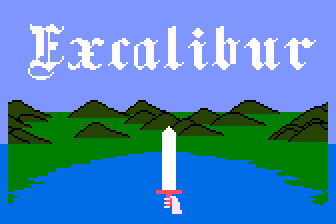
After a laudable opening sequence - wherein the Lady of the Lake's hand comes out of the water, brandishing the sword Excalibur - the gamer is taken to the throne room at Camelot. Six knights already sit at the Round Table, and more follow during the course of the game. Each knight is identified by a unique shield, while Queen Guenevere is depicted as the crown. The closer each knight (or queen) is to the circular table, the more loyal he supposedly is to Arthur.
While in the throne room, Arthur has the option of giving a gift or honor to an individual, selecting knights to accompany him on campaign or banishing those he feels are on the verge of treason (needless to say, this should only be used in dire circumstances). Arthur's popularity with his own people depends upon many factors, including how his army has been faring, how sensitive he is to each knight's personality (some like being honored, while others prefer cold cash) and who says what to whom.
By moving the crown (symbolizing Arthur) up the hall, the King enters his treasury. Here is displayed the wealth of the Kingdom. Arthur can raise or lower taxes, hire armies, check on his prestige factor (if it's too low, he's likely to be attacked, the higher his prestige, the more likely that other kings will offer tithes for protection) and hear whatever news there is. A strategic map of the country also indicates Arthur's friends (pink), enemies (blue) and neutral territories (green).
The third room is Merlin's laboratory. Here, the young King can ask the mighty sorcerer to send a plague or pestilence against a strong enemy, change the opinion of another king or see into a rival's personal affairs. The latter includes a survey of the other King's cash, armies, prestige, knight followers and opinions about other lords. Merlin's powers are not unlimited, though. He often has to rest after casting a series of spells and he won't reappear until his powers have been restored.
When a rival king leads an army against Camelot, Arthur's crown flashes a warning. When the army arrives, a formal challenge will be issued and the king can either fight or wait. The invaders will pillage the town if left alone.
If Arthur fights, he and his knights are transported to the battlefield. Peasants always kill a number of invaders before the battle proper. Before the action begins, garners set the positions their knights will move to and can spy on the strength of individual opponents. Then, a push of the START button starts the armies toward each other. When they meet, they come out bashing. Although Arthur can adjust each knight's position during battle, if the tide turns against Camelot, knights might turn and flee. When panicked, a knight's shield turns into a checkerboard pattern and he won't respond to any directions. If too many knights turn tail, Arthur can retreat.
A lost battle demoralizes the knights while a victory wins prestige. Prestige brings tithes from petty kings in exchange for protection, but first Arthur must visit the castle in question to set his fees. The son of Pendragon doesn't have to wait for enemies to attack; he might want to lead his armies against a king on enemy territory.
All in all, Excalibur is a grand effort. Its wargame-style graphics (mostly symbols, with some words) are colorful and easily understood, while the game itself is playable again and again. Garners will definitely find truth in the words, "Heavy lies the head that wears the crown".
King Arthur's job was among the hardest of them all: to unite and bring peace to the warring factions of Britain, uphold and defend the high ideals on which Camelot was founded, conduct high-level diplomacy with faithful knights and archenemies alike and prove to a dubious public that he truly was the rightful King of all Britain. Not work for the faint of heart. Although Excalibur isn't a game for the weak, since it requires a fair amount of patience, Machiavellian diplomacy, and a good military mind.
The rulebook alone should serve to warn off those garners less comfortable with strategy games. Even though the actual play-mechanic is explained quite simply in several pages, all the clues for winning the game are contained in an enclosed novelette. Here, would-be Once and Future Kings have the chance to hear Merlin's sage advice on subjects ranging from the tax base to honoring faithful knights. Simply put, players who hope to make good their claim of kingship will find the book essential reading.
After a laudable opening sequence - wherein the Lady of the Lake's hand comes out of the water, brandishing the sword Excalibur - the gamer is taken to the throne room at Camelot. Six knights already sit at the Round Table, and more follow during the course of the game. Each knight is identified by a unique shield, while Queen Guenevere is depicted as the crown. The closer each knight (or queen) is to the circular table, the more loyal he supposedly is to Arthur.
While in the throne room, Arthur has the option of giving a gift or honor to an individual, selecting knights to accompany him on campaign or banishing those he feels are on the verge of treason (needless to say, this should only be used in dire circumstances). Arthur's popularity with his own people depends upon many factors, including how his army has been faring, how sensitive he is to each knight's personality (some like being honored, while others prefer cold cash) and who says what to whom.
By moving the crown (symbolizing Arthur) up the hall, the King enters his treasury. Here is displayed the wealth of the Kingdom. Arthur can raise or lower taxes, hire armies, check on his prestige factor (if it's too low, he's likely to be attacked, the higher his prestige, the more likely that other kings will offer tithes for protection) and hear whatever news there is. A strategic map of the country also indicates Arthur's friends (pink), enemies (blue) and neutral territories (green).
The third room is Merlin's laboratory. Here, the young King can ask the mighty sorcerer to send a plague or pestilence against a strong enemy, change the opinion of another king or see into a rival's personal affairs. The latter includes a survey of the other King's cash, armies, prestige, knight followers and opinions about other lords. Merlin's powers are not unlimited, though. He often has to rest after casting a series of spells and he won't reappear until his powers have been restored.
When a rival king leads an army against Camelot, Arthur's crown flashes a warning. When the army arrives, a formal challenge will be issued and the king can either fight or wait. The invaders will pillage the town if left alone.
If Arthur fights, he and his knights are transported to the battlefield. Peasants always kill a number of invaders before the battle proper. Before the action begins, garners set the positions their knights will move to and can spy on the strength of individual opponents. Then, a push of the START button starts the armies toward each other. When they meet, they come out bashing. Although Arthur can adjust each knight's position during battle, if the tide turns against Camelot, knights might turn and flee. When panicked, a knight's shield turns into a checkerboard pattern and he won't respond to any directions. If too many knights turn tail, Arthur can retreat.
A lost battle demoralizes the knights while a victory wins prestige. Prestige brings tithes from petty kings in exchange for protection, but first Arthur must visit the castle in question to set his fees. The son of Pendragon doesn't have to wait for enemies to attack; he might want to lead his armies against a king on enemy territory.
All in all, Excalibur is a grand effort. Its wargame-style graphics (mostly symbols, with some words) are colorful and easily understood, while the game itself is playable again and again. Garners will definitely find truth in the words, "Heavy lies the head that wears the crown".
The Book of Atari Software · 1984Rating: A
The brightly glowing sword rising slowly out of the water on the title page sets the scene for the adventure-war game Excalibur. It transports you back to the days of Arthurian legend and the small kingdom called Camelot. Here Arthur forged a new kingdom with the aid of Merlin the magician and the prowess of the knights of the Round Table.
Chris Crawford and his staff of programmers at Atari's Games Research spent twenty months developing this mammoth game, perhaps the largest ever designed for the Atari computer. For you to play the interconnected segments of the game, you must constantly reload disk files. The object is to unite Britain. This task proves difficult because Camelot, a small kingdom, has few knights to aid in the conquest. In addition, rival kingdoms with power-hungry kings surround it. Arthur must bide his time, meanwhile raising and training an army both for defense and offense. To achieve his objective requires diplomacy rather than fighting, lest he weaken his meager forces further in profitless combat. Instead he makes alliances, demanding tribute for protection. To accomplish this, he must first prove to the lesser kings that he can defeat them in battle. Solving this problem requires subtlety and experience. Luckily, he has the aid of his knights and Merlin. Merlin is both powerful and loyal, but the knights less so. Watch where they stand in the throne room. Loyal warriors stand close to the throne. Some can be influenced by gifts or honors, and may flee to save themselves in battle rather than fighting for their king. Merlin, however, uses his magic to help Arthur. But the more he uses his power, the weaker it becomes, and this limits his ability. He has constructed a map room for the king that shows al of the British kingdoms and reveals enemies and news. All magic takes place in his own room. There he can cast a plague on an enemy's army, or pestilence on a rival's crops, weakening them in their opposition to Arthur. From here he can invisibly transport Arthur to another king's castle to spy on the treasury (to determine the enemy's wealth), the throne room (to tally the power of the king's knights) or the map room (to gauge the king's feelings towards Camelot or another kingdom).
Arthur's own treasury room marks the location of all financial decisions, such as raising taxes and spending money to raise an army. Here he keeps records of tribute paid to him or that he must pay. One column in the records lists the actual values, while a second lists projections (subject to change by joystick control).
If Arthur decides to battle a neighbor, he goes to the map room and declares war on that kingdom, which then turns red on the map. Green signifies neutrality. Next, Arthur moves to the Round Table Room and chooses knights to help him fight. Each knight brings along the peasants that he has trained as soldiers. Arthur should leave at least one knight behind to defend the kingdom. When he exits the throne room, he enters the countryside outside the castle. The computer pauses here to load a large, scrolling map that shows the entire island of Britain, its rivers, seas, castles, and farmland. Arthur and his small band of knights march cross-country to the enemy king's land and begin to pillage his crops. If the enemy king decides to fight, a sword appears in challenge. The computer now pauses to load the battle portion of the game, which resembles Crawford's Legionnaire wargame. Two rows of knights face each other on the field, each designated by a shield (one of which spells Crawford's name backwards). Moving the cursor to a knight reveals his name and the number of soldiers with him. You give commands by moving the cursor to a knight, pressing the button, and repositioning the cursor to where you want the knight. The battle can become quite dynamic, with new orders given constantly as the battle progresses. When the knights meet, they flash and you hear clanging sounds. Strength, courage and tactics determine the outcome. The novice relying on weaker forces often loses the first battle and thus the game.
The game's graphics vary widely. The castle rooms are plain yet informative, but Merlin's room is superbly rendered. Images there sparkle and fade magically. The scrolling map of Britain employs wonderful detail and color, but the battle scenes show only the shields to represent knights.
Excalibur is destined to become a cult game. A highly complex game of strategy, it requires hours, sometimes tens of hours to play. Fortunately, it has a save-game option. It appeals mainly to the seasoned wargamer or fantasy role-player. Although slow, it holds your interest over an extended time once you have mastered some of the basic elements of play. It requires patience and restraint, certainly, and the novice will need to exercise them to avoid losing the game quickly and becoming discouraged. The level of difficulty alone may discourage many beginners, but those who persevere will find an ample reward in the game's incredible depth.
Chris Crawford and his staff of programmers at Atari's Games Research spent twenty months developing this mammoth game, perhaps the largest ever designed for the Atari computer. For you to play the interconnected segments of the game, you must constantly reload disk files. The object is to unite Britain. This task proves difficult because Camelot, a small kingdom, has few knights to aid in the conquest. In addition, rival kingdoms with power-hungry kings surround it. Arthur must bide his time, meanwhile raising and training an army both for defense and offense. To achieve his objective requires diplomacy rather than fighting, lest he weaken his meager forces further in profitless combat. Instead he makes alliances, demanding tribute for protection. To accomplish this, he must first prove to the lesser kings that he can defeat them in battle. Solving this problem requires subtlety and experience. Luckily, he has the aid of his knights and Merlin. Merlin is both powerful and loyal, but the knights less so. Watch where they stand in the throne room. Loyal warriors stand close to the throne. Some can be influenced by gifts or honors, and may flee to save themselves in battle rather than fighting for their king. Merlin, however, uses his magic to help Arthur. But the more he uses his power, the weaker it becomes, and this limits his ability. He has constructed a map room for the king that shows al of the British kingdoms and reveals enemies and news. All magic takes place in his own room. There he can cast a plague on an enemy's army, or pestilence on a rival's crops, weakening them in their opposition to Arthur. From here he can invisibly transport Arthur to another king's castle to spy on the treasury (to determine the enemy's wealth), the throne room (to tally the power of the king's knights) or the map room (to gauge the king's feelings towards Camelot or another kingdom).
Arthur's own treasury room marks the location of all financial decisions, such as raising taxes and spending money to raise an army. Here he keeps records of tribute paid to him or that he must pay. One column in the records lists the actual values, while a second lists projections (subject to change by joystick control).
If Arthur decides to battle a neighbor, he goes to the map room and declares war on that kingdom, which then turns red on the map. Green signifies neutrality. Next, Arthur moves to the Round Table Room and chooses knights to help him fight. Each knight brings along the peasants that he has trained as soldiers. Arthur should leave at least one knight behind to defend the kingdom. When he exits the throne room, he enters the countryside outside the castle. The computer pauses here to load a large, scrolling map that shows the entire island of Britain, its rivers, seas, castles, and farmland. Arthur and his small band of knights march cross-country to the enemy king's land and begin to pillage his crops. If the enemy king decides to fight, a sword appears in challenge. The computer now pauses to load the battle portion of the game, which resembles Crawford's Legionnaire wargame. Two rows of knights face each other on the field, each designated by a shield (one of which spells Crawford's name backwards). Moving the cursor to a knight reveals his name and the number of soldiers with him. You give commands by moving the cursor to a knight, pressing the button, and repositioning the cursor to where you want the knight. The battle can become quite dynamic, with new orders given constantly as the battle progresses. When the knights meet, they flash and you hear clanging sounds. Strength, courage and tactics determine the outcome. The novice relying on weaker forces often loses the first battle and thus the game.
The game's graphics vary widely. The castle rooms are plain yet informative, but Merlin's room is superbly rendered. Images there sparkle and fade magically. The scrolling map of Britain employs wonderful detail and color, but the battle scenes show only the shields to represent knights.
Excalibur is destined to become a cult game. A highly complex game of strategy, it requires hours, sometimes tens of hours to play. Fortunately, it has a save-game option. It appeals mainly to the seasoned wargamer or fantasy role-player. Although slow, it holds your interest over an extended time once you have mastered some of the basic elements of play. It requires patience and restraint, certainly, and the novice will need to exercise them to avoid losing the game quickly and becoming discouraged. The level of difficulty alone may discourage many beginners, but those who persevere will find an ample reward in the game's incredible depth.
| Overall rating : | A | Controllability: | A- | Error handling: | N/A |
| Game concept : | A | Skill involved: | A | Documentation: | B+ |
| Creativity: | A- | Challenge: | A- | Holds interest ?: | B+ |
| Game depth : | A | Graphics: | B | Value for money: | A- |