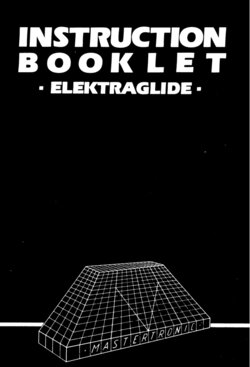

Atari 8-bit - Mastertronic (USA) - 1986
Elektra Glide
- Genre
- Racing - Miscellaneous
- Year
- 1986
- Language
- Machine Language
- Publisher
- Mastertronic (USA)
- Controls
- Joystick
- Developer
- —
- Players
- 1
- Country

- Programmer(s)
- Billyard, Adam Michael
- License
- Commercial
- Graphic Artist(s)
- —
- Medium
- Sound
- —
- Rarity
- 6
- Cover Artist(s)
- —
- Serial
- ICD0118
- Dump
- —
OTHER VERSIONS WITH THE SAME TITLE (1)
ADDITIONAL COMMENTS
Excerpts from an interview with Adam Billyard by James Hague:
JH: 'Was 3-D graphics programming rough in those days?'
AB: 'Quite bizarrely nothing much has changed, since CPUs, while much faster, still benefit from many, but not all, of the tricks we used to use. On the Atari 800, on which I wrote "ElektraGlide," you didn't have the processor grunt to do things properly so it was all about writing what you might describe as "soft 3-D systems"--3-D systems that behaved like 3-D but were in fact a big fudge. I was traveling around Turkey at the time and was quite obsessed with what the view of the road looked like through the front windshield of the buses I traveled on!'
JH: 'What tricks did you use to get things fast enough on an Atari 800?'
AB: 'Oh gosh it's a long time ago! Lots of self-modifying code for loops; you'd always overwrite loop set-up variables with the correct values so you could keep the loop in-line--function calls were expensive. Heavy use of lookup tables for pretty much anything involving math, since the 6502 only had 8-bit add and subtract instructions. The general method was often to write BASIC programs to generate the lookup tables which you dumped into the SYNASM assembler or Atari's Macro Assembler.'
JH: 'Specifically, what tricks did you use in "ElektraGlide"?'
AB: 'There was a whole bunch of neat stuff in there! Many games on the Atari 800 ran at 160x96 resolution with two bits per pixel. Since processor performance was so low you needed to minimize how much pixel painting you did. Consequently, lots of the games used redefined character sets, allowing the program to paint just 40x12 characters to cover a full screen in the worst case. Most of the time you didn't need to even do that because the hardware display lists allowed you to scroll the display over large character-mapped areas by flipping a few registers.
"ElektraGlide," unusually, used a bitmapped display in 160x96 mode. One of the technical aims of writing the game was to have real large objects "moving" on the display, unlike the endless 2-D scrolling games that were around. I say "moving" since no way could the processor actually repaint large objects fast enough. It was all a lot of smoke-and-display-lists, so to speak.
I used display list interrupts every other scan-line so I could have fine grain control. The road you were on twisted and turned by horizontally scrolling each scan-line in the display list to give the effect of you coming up on curves. Display list interrupts allowed the rolling colors down the edges of the road. When a tunnel, which eventually filled the screen, came up, I just set up interrupts to change the color registers further and further up the display and also restore the colors further and further down the display with the effect that you got this big looming wall of a tunnel approaching. The tunnel entrance was superimposed afterward using a spare player! More frightening was the case where the road curved inside a tunnel. I needed to blank out the part of the road occluded by the supposed tunnel wall. This was done by placing a large player at the apex of the curve and switching the player priorities at that apex scan line. I did a similar gag for exiting the tunnel, but ran out of players. On overscanned TVs, the darkness of the tunnel runs out at either edge revealing the coming landscape.
I needed to erase the contents of players often, but there wasn't enough time to erase that huge 128 bytes of player memory. I had a system where I could spread that memory fill over several frames just doing thirty-two bytes a time. Sad, isn't it!
The moving objects coming along the road were all drawn at full screen resolution and then resampled, by a program I wrote, down to varying sizes, giving a nice smooth sequence of images that could be shown one after another. In retrospect, it was my first attempt at texture mip-mapping. There was no possibility of drawing these fast enough, so the bitmap images were encoded as collections of players, some horizontally stretched, some not. It worked pretty well.'
JH: 'How did your Atari 800 games do commercially?'
AB: 'Really well in Europe. They were all number one in the charts for a time. Things like "ElektraGlide" did around forty to fifty thousand units.'
1 / 5
Disk 1