Atari 8-bit - Datasoft - 1985
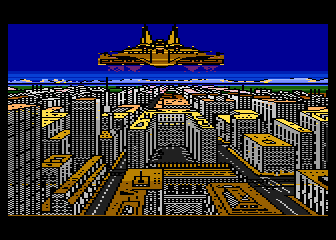
Alternate Reality - The City
- Genre
- Adventure - RPG (3-D)
- Year
- 1985
- Language
- Machine Language
- Publisher
- Datasoft
- Controls
- Joystick / Keyboard
- Developer
- Paradise Programming
- Players
- 1
- Country

- Programmer(s)
- Price, Philip
- License
- Commercial
- Graphic Artist(s)
- Skinner, Craig
- Medium
- Sound
- Gilbertson, Gary
- Rarity
- 7
- Cover Artist(s)
- —
- Serial
- 1445
- Dump
- Download
OTHER VERSIONS WITH THE SAME TITLE (1)
1 / 2
Disk 1
ADS (1)
CATALOGS (2)
TIPS (1)
Map
From Atari User - July 1987
TRIVIA (1)
Excerpts from an interview with Philip Price by James Hague...
JH: "What was the most difficult part of writing The City?"
PP: "I had no knowledge of 3-D. I was unaware of the techniques and terminology that existed in the academic world, so I had to reinvent many things. I used a vertical, single line Z-buffer - though I didn't know it was called that at the time - and a number of techniques to cull the polygons. I used self-modifying code in the loops that did the incremental texture mapping. I did cycle-counting to allow hardware sprites to be in two places at once. It was a challenge to do 3-D fully textured mapped graphics - even with fixed ninety degree turns - on a computer that ran at less than 2MHz and had 48K of RAM. Keeping track of characters' blood alcohol level, disease incubation time, neural and blood poison was not too difficult. It was fun to have a character's reaction time decrease as they became intoxicated, as was the wobbling and finally the blackouts."
PP: "The movie-like intro - with pan-shots, synchronized audio and video - was the most fun, though most of the conversions heavily edited the intro and didn't have all of the effects. The 8-bit Ataris were awesome in their day and the Apple II and C64 were hard for Datasoft's programmers to convert my game to, so they cut some corners."
JH: "Were the sequels planned out before the original was written or were they designed after the fact?"
PP: "The sequels were planned from the start. I wanted an interwoven series of games that allowed multiple ways of solving the problems and that had a plethora of plots and sub-plots. I planned to allow players to directly go back and forth between the sequels, with prior games being patchable and having versions. Sadly, in the conversions, Datasoft didn't follow my technique for laying out data on the disk, and therefore the conversions would not be able to bootstrap to other games in the series. But the Atari 800 version always was ready for it. I probably should have tried to control the conversion process more."
JH: "Is there a way to win the series as it stands? Is there some ultimate goal you can attain?"
PP: "As it stands, no. My concept from the start was that The City and every sequel were to be patchable by later games in the series. One subtle patch to The City, done in either Wilderness, Revelation or Destiny would change the characteristics of Acrinimiril's gate. It would then become a gateway into an alternate universe, the one Acrinimiril came from. You could enter it with the proper knowledge. It would seem like you could always do this, but in technical terms it would only exist after the patch. Thus, you could win with only The City, but only after the patch."
PP: "The series itself had many possible endings. I believe in free will and wanted people to choose their destinies, not have me cram it down their throats. A person in the final game in the series would have to make some heavy choices. Should I annihilate the planet we are orbiting that is populated with aliens who had kidnapped me? Should I just return to Earth? Should I take the alien megaship I am in with me to Earth? Should I destroy it? These were all final choices in the end, each with probabilities of certain consequences occurring from those choices."