
Atari ST - 1989
Flu
- Genre
- Tutorial
- Year
- 1989
- Language
- [unknown]
- Publisher
- [no publisher]
- Controls
- Mouse
- Distributor
- —
- Resolution
- Low / Medium / High / VGA
- Developer
- [n/a]
- ST Type
- ST, STe, TT, Falcon030 / 0.5MB
- Licensed from
- —
- Programmer(s)
- Woodside, George R.
- Country

- MIDI
- —
- Software
- English
- Version
- 1.20
- Box/Instructions
- English
- Number of Disks
- 1 / Double Sided / HD Installable
- License
- PD / Freeware / Shareware
- Dump
- Download
- Serial
- —
- Dump format
- MSA
- Protection
- —
OTHER VERSIONS WITH THE SAME TITLE (1)
INSTRUCTIONS
May, 1989

Familiarity with the appearance of the attacks of known viruses would be
helpful in recognizing when one is present. For that purpose, I have provided
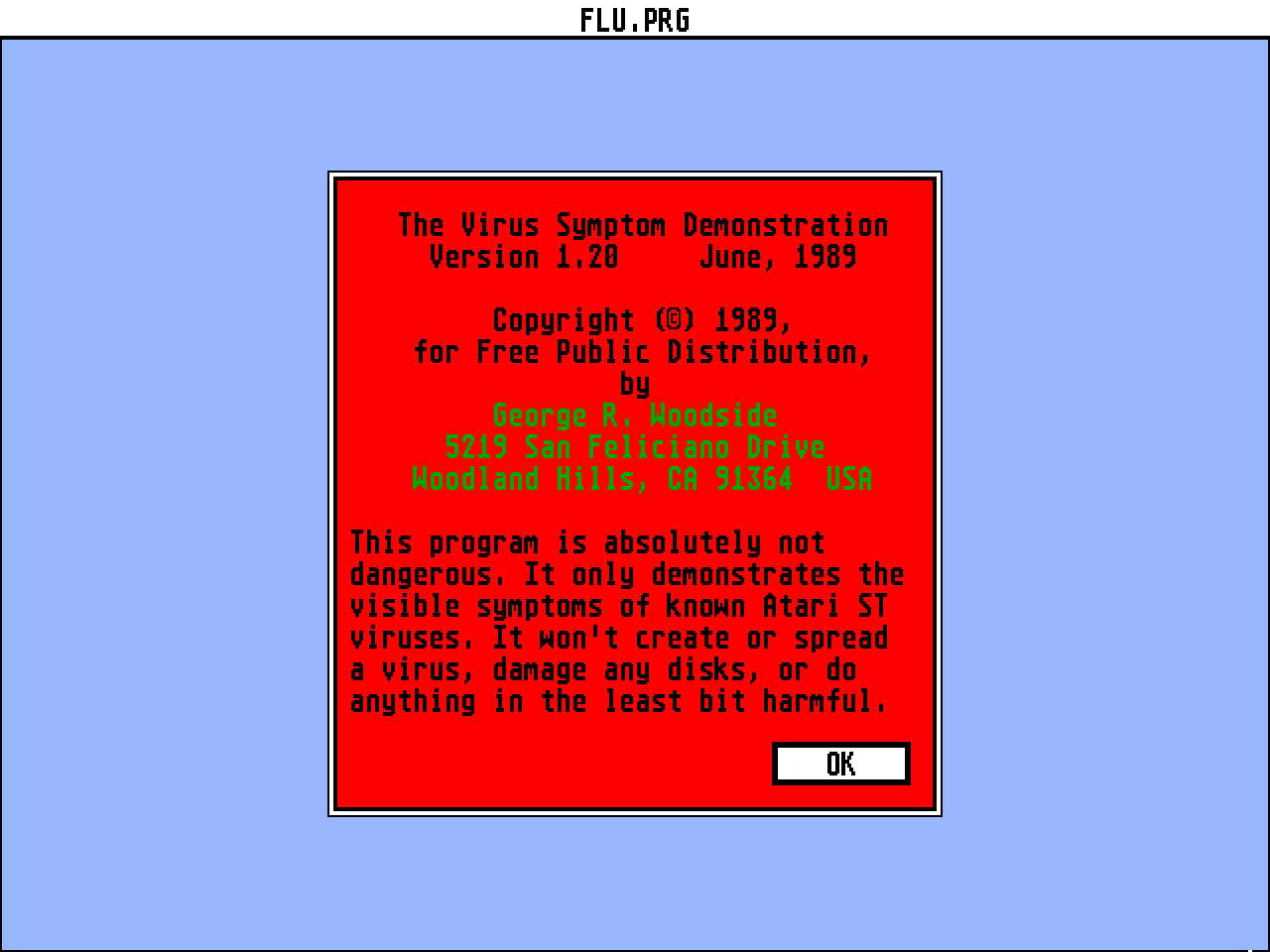
the program "FLU". It is a demonstration program. It does not contain any of
the code present in any virus for the installation of the virus, or the
spreading of the virus. What it does contain is the non-destructive attack
code of several viruses. These attacks are either audio or visual, so that
there is evidence of the attack occurring. There is no simulation of any of
the virus attacks which cause damage to disk data, since there is no way
to recognize when such an attack is occurring (and, of course, the purpose
of the program is to aid in recognizing the symptoms, not to destroy disks!).

"FLU" is absolutely safe. The program can be viewed as a simple novelty,
which does some strange display alterations. But by running it, and becoming
familiar with the symptoms it displays, you will be capable of recognizing
the characteristics of the attack of several current ST viruses.

Two of the simulations, the "BLOT" virus and the "SCREEN" virus, attack in
a nearly identical manner. They step on a small portion of the screen. When
speeded up to display the symptoms, they have the appearance of drawing lines
from the top and bottom of the screen. However, when the attack occurs at the
speed at which the virus really operates, the attack would appear more like
a small blot appearing on the screen, since the screen would have most likely
been altered or redrawn by the application program between virus attacks.

The "FREEZE" virus is probably the most difficult of the non-destructive
viruses to recognize, since it is the most subtle. It takes over the
ST for an ever increasing period of time, causing a gradual slowing the
machine. Again, the demonstration runs at a significantly higher speed than
the real virus.

George R. Woodside

Voice:         (818) 348-9174
Compuserve:    76537,1342
GEnie:         G.WOODSIDE
USENET:        woodside@ttidca
    or:        ..!{philabs|csun|psivax}!ttidca!woodside
US MAIL:       5219 San Felicaino Drive
               Woodland Hills, CA  91364  USA