

Atari ST - 1992
F4 Monitor
- Genre
- Hardware - Testing
- Year
- 1992
- Language
- Machine Language
- Publisher
- [no publisher]
- Controls
- Keyboard
- Distributor
- —
- Resolution
- —
- Developer
- Atari Corporation
- ST Type
- Falcon030 / 0.5MB
- Licensed from
- —
- Programmer(s)
- Stedman, Roy
- Country

- MIDI
- —
- Software
- English
- Version
- 2.8 [sourcecode]
- Box/Instructions
- English
- Number of Disks
- 1 / H / HD Installable
- License
- Unreleased
- Dump
- Download
- Serial
- —
- Dump format
- Zip-packed folder
- Protection
- —
INSTRUCTIONS
F4 Monitor Documentation	(what little there is)
------------------------------------------------------
Last Updated: 09JUN92 : RWS : For V2.8
------------------------------------------------------

TRIGGER NUMBERS ON PARALLEL PORT
================================
	Except in exceptions, even numbers are "interesting"
spots in the code (R/W's, etc), and odd numbers are error conditions.

EXAMINE
=======
	The location counter increases automatically by the
data size every time you hit return or change the data. The
counter retreats by the size of the data if you press '^'.
the '<' key rereads the same location. ESC or . exit back
to the main menu.

	1 = single mode. If you change the data, the location
counter will not advance and the newly changed data will be
read back. The location counter will advance if you press return
and retreat if you press '^'. Default off.

	B,W,L = Byte/Word/Long data size

RAM
===
	1 = shows refresh and size registers, allows user to change
	2 = tests data lines by walking ones and zeroes across longword
	3 = random address check. Checks up to 64K space semi-randomly
	4 = disturbance. Fills ram block with a changing pattern and
		verifies it stays.
	5 = Code in RAM. Sticks small piece of code into RAM that shoves lots of
		stuff on and off the stack.
	6 = BitString test. Treats ram as long contiguous string of bits. Tries to
		rotate a one and zero through it. This takes a long time if the RAM
		size is large.
	7 = Simulated code. Randomly tries to imitate code running from RAM.
		Doesn't work.
	8 = Move 16. loops a move16 instruction (start->end). Doesn't test data.
		Moves data from src to dests using b,w,l transfers. This tests system cache.
		ESC WON'T EXIT!!. Must use Examine to check.
ADMA
====
	1 = runs Disk2.s - simple seeks in and out of floppy.
	2 = runs disk5.s - uses read/write track to do DMA to memory - currently fails w/video on..
	3 = sets up for large sound DMA playback/record (with rascal-area loopback)
	4 = turns sound DMA on loopback repeat record and play. Leaves it there and exits to menu.

BDMA
====
	S - Doesn't do much - should run a SCSI test
	2 - Fast writes and reads a byte from the SCSI mode register. Reports failiures
	C - Runs SCC test from TT diagnostic

VIDEO
=====
	1 - 'Standard' VGA 8 bpp - as defined by G. Mokler.
	2 - SVGA timing. Probably for narrow screen
	3 - 24 bpp VGA timing. Sometimes for narrow screen
	4 - Tiny VGA a 140 X 80 or so screen. Small NUMREQ
	5 - Narrow Screen 	???
	6 - Less Narrow Screen	???
	P - fills palette with different values/shades of blue (depends on code)
	C - Clears video ram to vbase+100000
	S - Fills video ram with $fffffff to vbase+100000
	F - Goes to Falcon mode menu.
	T - Goes to TT mode menu (modes 0-7 & Test lines, (D draws atari sign)
	+ - Saves VTG registers
	- - Restores VTG registers
	L - Draws test pattern. Box around screen & crossed lines from corners

--- unsupported, may not exist ---
	D - Draws Atari & logo on top of screen
	Y - same, but y = 200-400
	Z - same but y = 400-600
	U - Draws incrementing horizontal lines
	G - draws horizontal color bars (1,2,3,4....)
	M - Draws test shades for true color
	R - Rotates palette
	A - String Art in Packed Modes (runs from RAM)

EXCEPTIONS
==========
	1 - allows easy setting of VME, SCU and SR interrupt masks
	2 - tries to autovector off the MFP. User Exception = worked.

FILL
====
	Word fills memory. Address step and word written may be added to.

KEYBOARD
========
	Resets keyboard, reads keypresses. Requires keyboard. Doesn't exit.

RTC
===
	Dumps first 16 bytes of RTC. Shows time.

JUMP
====
	Jumps to code anywhere.

DUMP
====
	Dumps a page of 256 bytes as hex and ASCII
	(non-printing characters show up as '.')
	ESC exits, CR = next page, ^ = previous page.

DOWNLOAD
========
	B - downloads binary serial data to destination address.
		Start sending binary data after  at end of address.
		data ends with an approx. 1 sec delay after last
		byte sent. ESC will exit while waiting for first byte.
		(so make sure your first byte isn't $1B)
		Data will not be echoed. This mode is about three times
		faster than the hex downloader.

	H - downloads ASCII hex data to destination. Data should be formatted
		as follows: XXXXXX.... Where XX is
		one or two ASCII hex digits [0..F]. ESC signals end of transmission.
		Since this uses the regular hex input routine, data will be
		echoed and strange characters will cause trouble.

	NOTE: Neither of these do flow control. However, the Hex downloader wil
		wait forever for characters to be sent. Any non-hex, non
		characters will cause unpredictable results.

	S - S-record downloader. Should work, but doesn't.

RESET
=====
	Executes a RESET instruction. Restarts cartrige. Mucks with Processor status LED's

VTBL
====
	The vector table prints the name of the exception taken
and stops. The exception number is displayed on the parallel port
and moved into the sr. Unassigned exceptions = 0 and unused = 1

NOW : location of offendng instruction (or so) is printed and
code returns to menu. WARNING!: This DOES NOT do proper cleanup/completion
of incomplete cycles. WATCH IT!

EXCEP
=====
	1 - allows setting the system IPL, and the SCU interrupt masks.
	2 - Tests MFP interrupter - returns exception vectored to #255

	V - copies VTBL into location $8-up and sets VBR to $0
		useful for changing vectors around.
	4 - Tests frame-grab on test jig. (must use V first).
	5 - Sets a counter on spurious interrupts (must use V first).

DSP
===
	1 - Tests DSP SRAM with DSP
	2 - Tests SSI Port with DSP. *SHORT* loopback required to work

CACHE
=====
	D - turns on data cache in CACR
	I - turns on instruction cache in CACR
	B - turns on both I+D bits in CACR
	X - clears both cache bits in CACR


MEMORY MAP: (as of v 2.2) - with new VTBL & stuff, this is changed a lot. Not detailed yet.
-------------------------
0	-	7 	: ROM
$8	-	$5030 	: ADMA TEST #2 (DiskRW)				= THESE ALL WENT UP BY ABOUT $800
$5030	-	$5040	: Exceptions (incl. NUMREQStore)		= when VTBL->RAM went in.
$5040	-	$50A0	: Video Test Variables (mostly for line draws)	=
$50A2	-	$54CC	: SCC test variables.				=

<$17000	-	: SYSTEM STACK (grows down)

$18000+	-	: Video Memory (top depends on resolution & mode)
		: NOTE: can overwrite DMA Sound buffers below.

$300000 -	$340000	: DMA Sound Buffer #1
$400000	-	$440000 : DMA Sound Buffer #2

$FA0000 -	$FC0000 : Cartrige ROM

$FFE00000 -		: Boot ROM (will be TOS)
TRIVIA (1)
Hardware
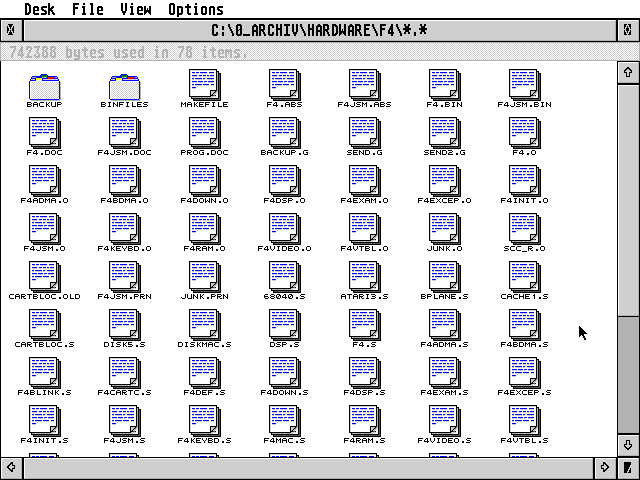
Needs to be burned to EPROMs. Hardware test cartridge files for Atari's never released Falcon040 computer.