
Atari ST - 1990
24BIT
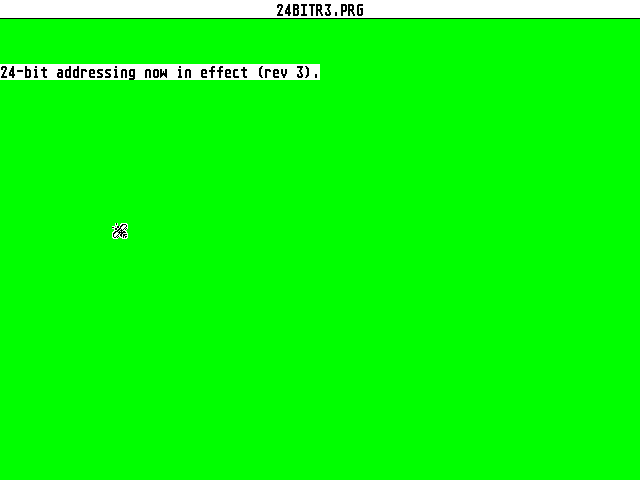
- Genre
- Patch / Driver
- Year
- 1990
- Language
- [unknown]
- Publisher
- [no publisher]
- Controls
- -
- Distributor
- -
- Players
- —
- Developer
- Atari Corporation
- Resolution
- VGA
- Licensed from
- -
- Programmer(s)
- [unknown]
- Country

- Graphic Artist(s)
- —
- Software
- English
- Game design
- —
- Box/Instructions
- English
- Musician(s)
- —
- License
- PD / Freeware / Shareware
- Sound FX
- —
- Serial
- —
- Cover Artist(s)
- —
- ST Type
- TT / 2MB
- MIDI
- —
- Version
- Revision 3
- Dump
- Download
- Number of Disks
- 1 / Double Sided / HD Installable
- Dump format
- MSA
- Protection
- —
OTHER VERSIONS WITH THE SAME TITLE (2)
INSTRUCTIONS
DOCUMENTATION FOR 24BIT.PRG
Revision 3 / December 10, 1990

The ST uses a 68000 CPU, which has a 24-bit address bus.  That means that
the high-order eight bits of a 32-bit longword used as an address don't
matter.  Some programs use those bits to mean something, like the type or
size of the thing a pointer points to.

Those programs are "not 32-bit clean," won't work normally on the TT,
because the 68030 CPU uses all 32 bits of a longword as the address.  If you
run them, you will get bombs or more horrible kinds of system crashes.

Running the program "24BIT.PRG" in your AUTO folder programs the
memory-management unit built into the 68030 so those eight bits are ignored
again.  Some programs which are not 32-bit clean will work after running
24BIT.PRG.

If you run an ST program on your TT and it bombs, you can consider doing
this:

	1. Reboot.  It's always a good idea to reboot after a program
	   bombs, because it might have put things in a funny state without
	   cleaning up after itself.

	2. Put 24BIT.PRG in your AUTO folder and reboot again so it
	   executes.

	3. Run the program that bombed.  If it works normally, then you
	   know you have to use 24BIT.PRG before you can run that
	   program.

Microsoft Write and programs written in compiled GFA BASIC 2.x, as well as
the GFA BASIC 2.x interpreter itself, are known to require the use of
24BIT.PRG.  GFA BASIC 3.x probably does, too.

There are a number of things to keep in mind:

There might be more wrong with a program than not being 32-bit clean.
programs that use the high eight bits of pointers might also play other
tricks which render them incompatible.

I used to think you had to disable the cache to run under 24BIT.PRG,
but I was wrong.

You can't access TT RAM using only 24 bits of address, so you can't be using
TT RAM and use this program.  If you have no TT RAM, or if you have some
installed but aren't using it, you can run this program. The program will
tell you if it can't run because there is something in TT RAM.  If you have
TT RAM but aren't using it, the program will run, and arrange it so the
system "forgets" that there is any TT RAM until you reboot.  That is the
price these programs make you pay.

Devices on the VMEbus can not be accessed using only 24 bits of address,
either, so you lose access to them, too, when you run this program. Since
this program can't "allocate" a VMEbus device the way it can TT RAM, there
is no way to protect against this, and the system will probably just crash
if you run a program that accesses the VMEbus after running this program.

Programs which actually pass 32-bit addresses with nonzero high bytes as
parameters to OS calls can still die, because all 32 bits are written to
(e.g.) the SCSI DMA controller.

24BIT.PRG must run in the AUTO folder because the TT Desktop itself uses TT
RAM if it's available, so 24BIT.PRG must run before the Desktop comes up.
In addition, 24BIT.PRG must appear in the AUTO folder before anything which
stays resident and has its TT-RAM-allowed bits set; otherwise 24BIT.PRG will
find that TT RAM isn't empty and refuse to let you into "24-bit mode."

The program 24BIT.PRG must not have its "load in TT RAM" bit set, because
otherwise it will find that TT RAM is not empty (the PRG itself is there)
and refuse to run.

----------------------------------------------------------------------

Technically speaking, this program rewrites the page tables in memory so
bits 31-24 are always mapped to zero.  This way programs which use the high
bytes of pointers can run.

If you have no TT RAM, 24BIT.PRG will program the 68030's memory management
unit and exit without taking up any resources.  It simply re-uses the memory
where the TOS ROM memory-management tables are.

The program will print a message and refuse to run if you aren't on a TT, or
if there is anything in TT RAM.  "Anything in TT RAM" is defined as follows:
the system variables _ramtop and _ramvalid are used to find out if you have
any TT RAM, and if you do, how much.  Mxalloc() is used to allocate all of
it.  If the call fails, it means there's something in there and the program
aborts.

If there's nothing in TT RAM, the program rewrites the page tables and does
a TSR so the TT RAM block it allocated isn't freed.  That way subsequent
programs which have their TT-RAM-enable bits set still won't load there.

This remapping trick will be defeated by programs which somehow install
themselves at the top of TT RAM and bump _ramtop down.  Do not run any of
these if you want to use 24BIT.PRG.  If you write software, don't write
programs that fool with _ramtop, or your users won't be able to use
24BIT.PRG to run their favorite "unclean" software.