
Atari ST - 1990
Johann's Blackjack Table
 1 / 3
1 / 3- Genre
- Gambling - Casino
- Year
- 1990
- Language
- Compiled C
- Publisher
- [no publisher]
- Controls
- Keyboard
- Distributor
- -
- Players
- 1 / 2+
- Developer
- Sozobon
- Resolution
- Low / Medium / High
- Licensed from
- -
- Programmer(s)
- Ruegg, Johann
- Country

- Graphic Artist(s)
- [n/a]
- Software
- English
- Game design
- Ruegg, Johann
- Box/Instructions
- English
- Musician(s)
- [n/a]
- License
- PD / Freeware / Shareware
- Sound FX
- [n/a]
- Serial
- —
- Cover Artist(s)
- —
- ST Type
- ST, STe / 0.5MB
- MIDI
- —
- Version
- —
- Dump
- Download
- Number of Disks
- 1 / Double Sided
- Dump format
- MSA
- Protection
- —
INSTRUCTIONS
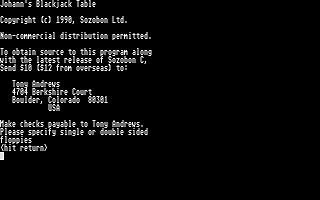
Johann's Blackjack Table
Copyright (c) 1990, Sozobon Ltd.

Non-commercial distribution permitted

Features:
	*  Simulates a Las Vegas blackjack table with 1-6 players
		(1-3 players in low resolution)
	*  Allows splitting, double down, insurance
	*  Players may play multiple hands at once
	*  Gives advice
	*  Various casino rules may be specified
		(number of decks, shuffle point, double down after split)
	*  Automatic players

See 'rules.doc' for further information.

	Johann Ruegg


---


Johann's Blackjack Table
Copyright 1990 Sozobon Ltd.

(1) The cards

	Blackjack is played with standard 52-card decks.  Each table
at a casino will be using from 1 to 8 decks shuffled together.  It is
best for the player to use the minimum number of decks.  Because of this,
it is almost impossible to find single deck games in Las Vegas.

	The program lets you select from 2 to 8 decks in play.  (option -D)

(2) The table

	Tables in a casino typically have the dealer standing on one side
and six chairs for the players on the other side.  The table has six
corresponding spots marked on it where bets are placed.  If the table
is not full, the casino may let you play 2 hands at a time; you will use
two adjacent spots.

	The program lets you select the number of players (option -p) and
lets each player occupy as many spots as they like as long as the total
is <= 6.  The name of each player will be asked.  If you give a name
that starts with "auto", the computer will play for these players.

(3) Money and chips

	Money can be exchanged for chips at the table.  However chips
can only be exchanged for money at the casino cashier's cage.  Bets
must almost always be made with chips.  The casino will let you exchange
more money for chips at any time (and may even give you credit).

	The program doesn't really deal with the issue of chips,
but each player starts with a fixed pot (option -P).  If you lose your
stake, you cannot add to it - you are out.  This is to encourage you
to not take more money out of your pocket in real life.  Leave the
table for a while and come back later.

(4) Shuffle and cut

	The house can shuffle the cards any time they choose.  Usually
however, they will use 50% to 80% of the cards before shuffling.
If 1 or 2 decks are being used, the cards will be dealt from the dealer's
hand.  If 4 or more decks are in play, a shoe will be used.  In either
case a special green plastic 'card' may be used to mark the shuffle point.
After the shuffle, one of the players will cut the deck by inserting the
green card somewhere.

	The program lets you select the shuffle point when you start up
(option -S).  When asked to cut, select a number between 0 and the
number of cards.

(5) Placing bets

	Each table will have a sign on it identifing the minimum and
maximum bets.  You usually cannot pass; if you are sitting at the table,
you must make the minimum bet each hand.  (If you are too slow making
a bet or are digging in you pockets for more money, the dealer may
skip you once or twice).

	Some players always bet the minimum (or always the same amount
anyway).  Others like to raise their bet after a win - if they then
lose, they are only losing "the casino's money".  Another strategy is
to raise your bet after a loss to make up the loss.

	The program will ask for each player's bet.  You can enter
a number or use these shortcuts (after the first bet):
		space - same bet as last time
		 'h'  - half of the last bet
		 'd'  - double the last bet

	The "auto" player's first bet must be entered as a number.  After
that they will keep betting the same amount except if named:
		"autom" who will raise after a loss
		"autoj" who will raise after a win

	If you specify the '-b' option, the program will ask if all
players want to bet the same.  Also, any player using more than one
spot will be asked if all his/her bets should be the same.

(6) The first 2 cards dealt

	Two cards are dealt to each bet.  The dealer will always get
one card face up and one card face down.  The players' cards will be dealt
face down if dealt from the dealer's hand; face up if dealt from a shoe.
When cards are dealt face down, the player can pick them up (with one
hand only) and only that player will see those 2 cards.

	The program lets you select whether you want the cards dealt
face up or not (option -u).  You can also choose to have the cards
dealt instantly (option -f).

	If all the players are "auto" players, you may want to turn
off all delays (option -F).

(7) Insurance and dealer's blackjack

	If the dealer has an ace as his/her up card, they will ask the
players if they want insurance.  A player has the option of betting
half their original bet as "insurance" against a dealer having blackjack.
They can look at their hand before deciding (some players like to take
insurance only if they have blackjack).

	Insurance pays 2-1 if they dealer's down card is a 10 or face card.
The dealer will check the down card after any insurance bets and before
players play.  If the dealer doesn't have blackjack, the insurace bets
are taken.  If the dealer does have blackjack, insurance bets win 2-1
but other bets are taken unless the player has blackjack too (which is
a push).

	If you take insurance on a non-blackjack hand, you either
lose the insurance bet immediately and play out your hand (no dealer
blackjack) OR win the insurance bet but lose your original bet (if
dealer has blackjack).  In the latter case, the dealer doesn't actually
take your original bet and pay off the insurance bet - he/she just leaves
the chips as they are since this has the same effect.

	If you take insurance on a blackjack hand, you either lose
the insurance bet immediately and win 1 1/2 with the blackjack (no dealer
blackjack) OR win the insurace bet but have a push with the original
bet (if dealer has blackjack).  Since you end up with an even money
win in either case, you can call "even money" and show your blackjack
when the dealer asks for insurance bets.  You will be paid even money
immediately.

	If the dealer's up card is a 10 or face card, he/she may have
an ace as the down card (an ace in the hole).  In the past, the dealer
would always check the hole card before player's played.  If they
had blackjack, all cards were turned face up and all bets were taken
immediately (unless a player had blackjack too - this is a push).
Many casinos now have a policy that the hole card is not looked at
when the up card is a 10 or face card until after players play out their
hands.  However, any additional money put on the table due to splits
and double downs is refunded if the dealer turns up a blackjack later.

	The program will ask players if they want insurance when the
dealer has an ace as the up card.  Players with blackjack who take
insurace are immediately paid even money.  Other hands either lose
the insurace bet or are protected with a push if the dealer has blackjack.

	The program checks for blackjack immediately if the up card is
a 10 or face card.

(8) Player's options

	Each hand is played starting from the player nearest the dealer's
left hand and proceeding clockwise.  If one player is playing more than
one bet, each must be played in turn (when cards are dealt face down, they
cannot look at other hands early).

	In a real casino, players can sometimes decide what to do before
it is their turn.  If they have blackjack, they can lay down their cards
and be paid right away.  As long as they don't need to draw, they can
indicate their desire to double down or split or stand immediately.
The program does not allow this since there is only one keyboard for
entering moves.

(8.1) Player's options: Blackjack

	If the player has blackjack (and the dealer doesn't) they should
lay down their cards (if dealt face down) and be paid right away since
there is no way the dealer can win or tie.  Note that if the dealer has
a 10 or face card and does not look at the hole card, they will not be
paid until later.

	The program pays blackjack immediately if cards are dealt face up.
If cards are dealt face down, you are prompted to hit a key (to simulate
the real life action of laying down your cards).

(8.2) Player's options: Draw or Stand

	After looking at the original 2 cards and looking at the dealer's
up card, the player can decide to draw more cards.  They indicate a desire
to do so by making a drawing motion with the hand holding the 2 original
cards (if cards are dealt down) or making the motion with their hand
(if cards are dealt up).  More cards are dealt (face up) until the player
is satisfied and decides to "stay" or "stand", or until the player has
a hand >21 and "busts".

	If cards were dealt face down, you indicate a desire to stand by
putting your original 2 cards face down on the table under your bet chips.
If you bust, you place your cards face up on the table and the dealer takes
your cards and your bet immediately.

	If cards were dealt face up, you indicate a desire to stand by
waving you hand back and forth.  If you bust, the dealer can see that
since they can see all your cards.

	The program lets you type ',' for a draw or '.' to stand.  If
you bust and cards are dealt face up, you lose immediately.  If you
bust and cards are dealt face down, you will be prompted to hit a key
(to simulate the real life action of laying down your cards).

(8.3) Player's options: Splitting pairs

	If the first 2 cards are a pair (or both have a value of 10 even
though they are not a pair) the player can split them into 2 separate hands.
You do this by laying down your cards if they were dealt face up and
adding another bet equal to the original bet.  The dealer adds a card to
each and you then play out each new hand.  However, if you split aces,
the new cards are dealt face down and you have no more play on them.

	If a split hand is a pair, you can resplit until you have up
to four hands (or some other casino limit).  Some casinos let you
double down on a split hand.  This is to the player's advantage if it
is allowed.

	The program lets you split up to 3 times if you have the money
needed.  Hit 's' to split.  If you want to forbid double down after split,
use the -a option.

(8.4) Player's options: Double down

	The player can double down with any 2 original cards (except
blackjack).  To do this you lay down the original cards if dealt face up
and add chips to double your bet.  You would normally only do this if
you have a hand with an ace or a hand whose value is 11 or less.  You
are then dealt one more card face down and must stand with this hand.

	The program will only let you double down if you have a hand
with an ace or 11 or less.  You hit 'd' to double down.  Doubling down
on a split hand is allowed unless you specify an option to not allow it.

	If you doubled down in real life, you would have two stacks of
chips.  The program shows you have doubled down by putting a '*' next
to the amount of your bet (if there is room - i.e. your doubled bet is
less than 100).

(8.5) Player's options: Advice

	The program lets you ask for advice on the above plays.  Hit
'a' to ask for advice.  Note that certain advice will be different
depending on the number of decks in play and whether double down after
split is allowed.  Also, if you don't have the money you may not be
advised to split or double down.

	If you just want to see a summary of the advice for a particular
table, use the '-T' option.

(9) Dealer Draws or Stands

	After all the players have played, the dealer plays out his/her hand.
First they turn up their second card.  If all players have busted or
have blackjack, they will stop here.  Otherwise, they will draw until
they have 17 or better (or bust).  Some casinos have the dealer draw
when they have a soft 17 (17 with an ace counting as 11).  It is better
for the player if the dealer stands with soft 17.

	The program lets you specify whether the dealer draws with soft 17.
(option -D).

(10) The showdown

	If the dealer does not bust, he/she will turn over each player's
hand and either take their bet (dealer's hand is better) pay off even
money (player's hand is better) or leave the original bet (if it is a
tie).

	If the dealer busts, he/she will quickly turn over each players
hand to make sure they didn't bust and will pay off even money.  (If
cards were dealt face down, you should have turned up your cards if you
busted).

	The program will either put a number equal to your original bet
in the spot, or take your bet, or leave your original bet.  Thus, when
asked to bet for the next hand, you can see whether you won, lost or tied
when you decide on your next bet.


Summary of options:

	-d		select number of decks (default 2)
	-p		select number of players (default 1)
	-P		select pot for each player (default 100)
	-a		forbid double down after split
	-u		deal cards face up
	-D		dealer draws on soft 17
	-S		set the shuffle point (default .4)
	-b		speed up asking about multiple bets
	-f		deal cards fast
	-F		do everything fast
	-T		print advice table and exit

Betting commands:

			enter a betting amount
	' '		bet same amount as last bet
	'd'		double last bet
	'h'		halve last bet

Playing commands:

	','		draw
	'.'		stand
	's'		split
	'd'		double down
	'a'		ask for advice