

Sports / Sports - Multi-Event · 1984
Summer Games
Published by Epyx
atarimania.com — atari-400-800-xl-xe-games-summer-games-5143
Information
- Genre
- Sports - Multi-Event
- Language
- Machine Language
- Controls
- Joystick
- Players
- 1, 2 (alt.), 2+
- Programmer(s)
- Landrum, Stephen H., Glover, Randy
- Graphic Artist(s)
- Murphy, Erin
- Year
- 1984
- Publisher
- Epyx
- Country
- USA
- License
- Commercial
- Medium
- Disk
- Rarity
- 4
- Serial
- 854D
Votes / Statistics
Rating: 7.7/10 · Votes: 86 · Downloads: 5,490 · Hits: 25,240
Additional Comments
Screenshots (6)



Cover Art (3)


Instructions (8)


Ads (1)

Book / Magazine Reviews (1)
Electronic Games · February, 1985
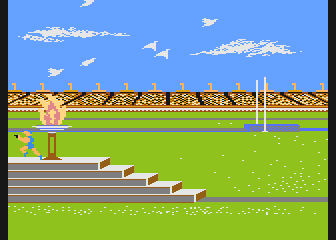
POLE VAULT:
The pole vault may very well be the hardest event. The player must remember four specific joystick maneuvers to clear the bar with room to spare.
The key to a successful vault lies in a good, solid plant and a strong kickup. Once this is achieved, releasing the pole is easy. In order to plant the pole, pull the stick back just as the tip of the pole hits the middle of the screen. This may seem too early, but the athlete takes some time to swing the pole all the way down.
Kicking up is the tricky part. Vaulters should kick up just when their man is at a 400 angle. The best way to kick up is to push forward, not once, but twice in rapid succession. This guarantees the kickup, and will make your vaults more successful. Don't forget to let go when the pole straightens out, though, or you'll still be holding the pole when your athlete belly-flops on the mat!
DIVING:
In diving, form is critical. The key is to land in an extended position with your head going in first, and your body following in a smooth vertical form.
The more rotations you do, the higher your rating - if you successfully complete the dive. The object is to start slow, and work your way up. Keep your eye on the diver's head, and when he's three quarters of the way down, push forward when his head is closest to the water. This will straighten him out immediately and assure a smooth dive. Although it may look impossible to track his head in the fastest rotation, keep practicing, it gets easier.
100-METER RELAY:
This race requires strategy and pacing. Runners should learn the precise place to begin a sprint that will use up all their energy just as the runner hits his relay partner. This spot is right where the crowd holds up the "U.S.A." sign. The second you see this sign, begin to sprint, and don't stop until you get to your next runner. If you do this right, you should never have to coast. The only time this strategy fails is on the last leg, because the last runner has a bit more energy, so you can begin your sprint a little earlier.
To pass the baton simply push the button when the two runners are closest together. When the placing is right, your relayer has the baton hand forward while the next runner has his receiving hand back.
100-METER DASH:
Not much to be said here, strategywise. Just try not to break too many sticks while jiggling them frantically.
GYMNASTICS:
This event can be simple or difficult, depending on the jump you are attempting.
For maximum points: always jump on the very tip of the springboard; always perform the 180° body twist by holding the stick right or left while leaving the springboard; and always push the button when the gymnast is in a vertical position on the horse for a powerful push-off. Once in the air, push forward for fast rotation. If the gymnast spins quickly, the push-off was done right, and can do 2 to 3 somersaults! If she moves slow, one is all she can complete, so don't push it. Pull back to land when her feet are closest to that mat, and if she leans left, pull the stick right to correct her (and vice-versa).
FREESTYLE RELAY AND 100-METER RACE:
In these two events, maintaining a rhythm is crucial. Aside from getting a good start and flip, one must excel in the strokes.
For maximum pull, push the button as the man's hand hits the water in front of him and hold it in for about a second as he pushes through the water. Then let go for a second, and push as he enters again, forming a rhythm of one second on, one off, one on, etc.
Initiate the flip turn when the man is just under one body-length from the edge. This will get you maximum push-off and can even put a second-placer ahead of his rival.
In the relay remember not to false start. It costs time!
SKEET SHOOT:
The main strategy behind skeet shooting is to memorize the pattern of targets. Know when the double skeets are coming, and be ready for them. If you know where they'll be, it becomes easier to pick them off.
The important thing to remember is not to lead the targets. Contrary to popular space game theory, you must put the site on the target to hit it. And don't forget to compensate for gravity pulling your gunsight down. Going to the middle of the screen immediately improves your chances of a successful hit.
Just remember, when competing in an Olympic event, you can hear the coach give you tips all day, but there's no substitute for good hard practice!
Comments (6)
Daniel Thomas MacInnes — 8 May 2011
Games like Summer Games are why Epyx was legendary. This was probably their best game on the Atari 800 (pity we never got Impossible Mission), and it's a different take on the Track-n-Field sports games. The designers put much more thought into the events than simple joystick waggling. Diving was always a favorite, pole vaulting a close second. The running and swimming events were more boring, and gymnastics was damn near impossible to figure out - once we learned what to do, it became much more fun. To my mind, this is still the gold standard in Olympics videogames.
eppy2000 — 26 Aug 2008
I always played the diving portion the most since it was a lot of fun and didn't require any joystick pounding or as much critical timing and coordination as the others. I liked the gymnastics, too. My sister, much to my chagrin, regularly got a perfect "10," back-to-back, so I never could beat that score! Never cared for the skeet shoot. I missed more than I hit. The swimming events were a little tedious. There was one HIGHLY annoying bug. If you got a "DQ" on the swimming freestyle events, that became a world record and you could not undo or beat that score. Unless of course, you got another DQ!
Andreas Koch — 18 Aug 2007
Well, the cart. version differs from the disk version: - max. 3 players can play - no highscore / olympic records save option There is still the option to play one or all events (but it is still mising to play more than one but less than all events, e.g. to choose several events out of the eight available ones)... And with the cart. version one no more has to be a disk-jockey ("turn disk over")...
Maggi1971 — 1 Jan 2007
I liked this game. It was a sports simulation, not a "jostick-killer" as Decathlion was. Summer Games, Winter Games and World Games where much better than this one, but these titles never appeared on the Atari 800. Shame on you, Epyx!!!
Jonny EOL — 12 Nov 2006
8 events, 18 national anthems and a decent mix of joystick mashing, careful timing and technicalities. Swimming relays were a bit dull, but otherwise a top sports sim.
Nixon — 17 Apr 2006
a nice summer olympic game, the events have niceg graphics and a cool gameplay esp. in multiplayer mode, one of the wasted wrists/joysticks game..