Arcade / Arcade - Maze · 1983
Capture the Flag
Published by Sirius Software · Developed by [n/a]
atarimania.com — atari-400-800-xl-xe-games-capture-the-flag-888
Information
- Genre
- Arcade - Maze
- Language
- Machine Language
- Controls
- Joystick, Keyboard
- Players
- 1, 1 vs. 2, Demo
- Programmer(s)
- Edelstein, Paul Allen
- Graphic Artist(s)
- Edelstein, Paul Allen
- Sound
- Sanger, George
- Cover Artist(s)
- Dowlant, James
- Year
- 1983
- Publisher
- Sirius Software
- Developer
- [n/a]
- Country
- USA
- License
- Commercial
- Medium
- Disk
- Rarity
- 8
- Serial
- 20017
Votes / Statistics
Rating: 8.1/10 · Votes: 3,015 · Downloads: 4,489 · Hits: 33,232
Additional Comments
Screenshots (3)


Cover Art (2)


Instructions (6)


Ads (2)

Book / Magazine Reviews (2)
Electronic Fun · February, 1984 · by William M. Brown · Rating: 4 / 4
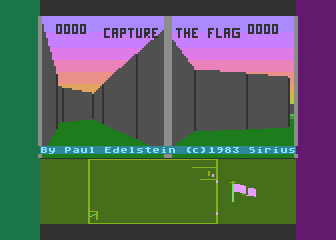
Turning Wayout into a two-player game with few other changes would have been enough of an improvement but Edelstein has gone whole hog here. Among other things, Capture gives you two separate 3-D maze views: one for the Invader, who enters screen left and tries to "capture the flag" by racing through the maze to one of the exits marked on the right, and one for the Defender, who enters from the right and tries to stop the Invader by tagging him before he can exit. Much like Wayout, each player's 3-D view shows the maze from his current standpoint within it, and there's also an overhead maze map (at the screen bottom) that displays as much of the maze as the two players have explored up to that point. Unlike Wayout, however, the number of mazes is infinite, being randomly re-drawn with each new game. You can also take either of the two roles, and either play solitaire against a very quick computer program or go true two-player against a human opponent. And where Wayout's logical but rather cumbersome movement system made working your way through any maze an agonizingly slow process, Capture gives you a two-mode system that sounds weird but works great.
There's also a gorgeous sunburst-colored sky over the maze (unlike Wayout's flat color), the joints between the walls are thicker (making it easier to "read" distances), and bouncy recombinant be-bop riffs come out of your TV speaker (like Wayout, the music gets louder as your enemy gets closer). I wouldn't want to push the negative comparisons with Wayout too far: the earlier game is a fine piece of work. But it's very rare to see a good game design wholly redone by the same designer, rarer still to see him improve on his original in every single respect.
If you're playing Invader, learn how to use the Walking Movement "fast-turn" feature. It's the only way you'll be fast enough to beat a good Defender.
Electronic Games · May, 1984 · by Vincent Puglia
Capture the Flag is truly a maze game. There are no pills and no ghosts, only the maze, one prize (the flag), two doors and two characters - the Invader and the Defender. The object is to go through the maze to one of the doors and capture the flag. Easy, right? That depends on which screen the gamer uses.
There are two main screens in Capture the Flag and each uses a different play mechanic. The lower screen, an overview of the labyrinth, uses Compass Movement - the fire button is depressed at all times and movement is in one of four directions (oh, yes, in the beginning the screen is blank and the maze becomes visible only if the player has traversed that area or "seen" it). The upper screen (actually a split-screen, one for each player) is a 3-D, first-person view of the maze. It uses Walking Movement. In this mode, the fire button isn't used. Although there are six types of movement, only two of them enable the character to walk; the other four are used for turning left or right.
By far, the upper screen is the more difficult to navigate through. It is also the preferred screen for the two-player option. To make sure neither player feels tempted to gaze at the lower screen, the map can be switched off by hitting the SELECT button.
Gamers are very likely to crack up with laughter during this option. What generally happens is the gamer walks into a dead end and then can't find his way out. Meanwhile, the music which gets louder with the close proximity of the opposing player begins to get more frenetic, and so the gamer slams into even more walls.
There's no need to look around any corners to see that Sirius' Capture the Flag is a winner.
Comments (5)
Atari A to Z (Pete Davison) — 16 Jul 2022
Capture the Flag is Paul Edelstein's quasi-sequel to Way Out, this time around featuring split-screen competitive gameplay, possibly the first ever implementation of first-person "strafing" (albeit not quite in the form we know it today) and an early soundtrack from George "The Fat Man" Sanger, of late '90s CD-ROM game fame. Let's Play! https://youtu.be/8SPk5jOAi3E
Paul Westphal — 11 Jan 2014
Amazing piece of programming and so was the copy protection. This is why you bought an Atari computer and not a 2600.
steve — 2 Jan 2014
Wow recently played this for the 1st time. Incredible smooth realistic graphics for the time Amazing feat of programming. Boy wish i had this back in the day, to show the spec c64 pals.
GADZombie — 19 Dec 2013
And the most incredible - it's very colorful and for two players at one computer! And very playable!
Dan — 26 Oct 2009
Wow! Regardless of whether it's real vector-based 3D or just raycasting, it's incredibly smooth for something on an 8-bit platform designed in the late '70s!