Atari ST - 1991
Traffic!
- Genre
- Brain - Logical / Puzzle
- Year
- 1991
- Language
- GFA BASIC
- Publisher
- [no publisher]
- Controls
- Mouse
- Distributor
- —
- Players
- 1
- Developer
- [n/a]
- Resolution
- Medium
- Licensed from
- —
- Programmer(s)
- Borges, Carlos Miguel
- Country

- Graphic Artist(s)
- Borges, Carlos Miguel
- Software
- English
- Game design
- Borges, Carlos Miguel
- Box/Instructions
- English
- Musician(s)
- [n/a]
- License
- PD / Freeware / Shareware
- Sound FX
- Borges, Carlos Miguel
- Serial
- —
- Cover Artist(s)
- —
- ST Type
- ST, STe / 0.5MB
- MIDI
- —
- Version
- —
- Dump
- Download
- Number of Disks
- 1 / Single Sided
- Dump format
- MSA
- Protection
- —
INSTRUCTIONS
                               TRAFFIC!

                           by Miguel Borges

                      carlos@garfield.cs.mun.ca


    When  Traffic! is first run, it will check the current resolution,
informing  you  if  the machine is not in the proper mode.  Currently,
Traffic  only  works  in  medium resolution.  If someone wants the GFA
Basic code to modify it for other resolutions, please mail me.
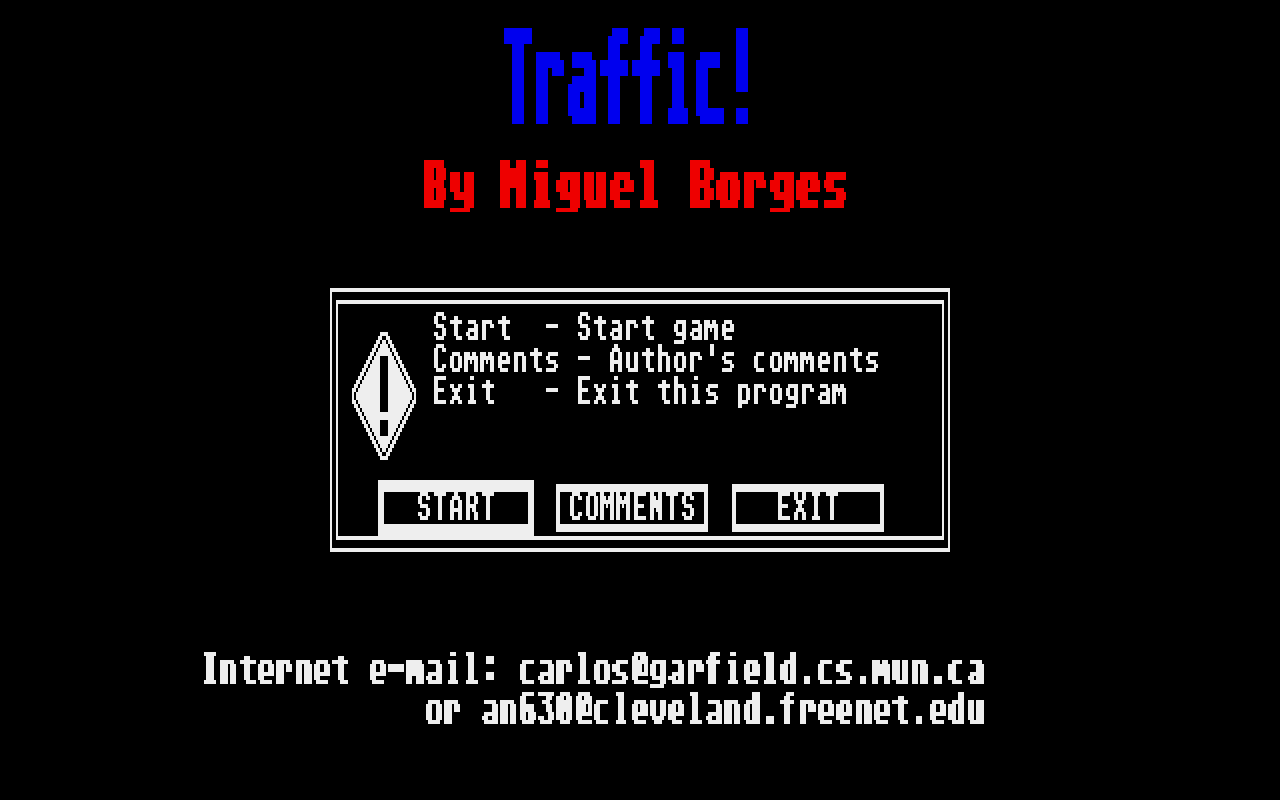
    After  the  initial  title  screen is displayed, you can begin the
game  by clicking on Start.  The screen changes to an overhead view of
part  of  a  city.   At  each  street  intersection, there is a symbol
representing  the  current  light  signal  position.   Vertical  lines
indicate  a  green  light for North-South traffic, and a red light for
East-West  traffic.   Horizontal  lines  indicate  a  green  light for
East-West  traffic,  and  red  for North-South.  Click on one of these
symbols to change the light.
    Cars  should  almost immediately start running around the screen.
They  are represented by the "#" symbol (hey - use your imagination (8
!  ).   Cars  will stop at a red light, and speed through green lights
(just  like  in  the real-life theory).  They will also line up behind
other cars waiting at an intersection.
    Points  are  awarded  for getting cars through your section of the
city.  You receive 10 points when one reaches the edge of the screen.
    The  game  ends  when a car is forced to wait at a red light for a
long  time.   This  time  is  calculated  based  on the number of cars
currently  on  the screen.  The more traffic, the more patient drivers
will be (unlike real life :-).