

Atari ST - 1987
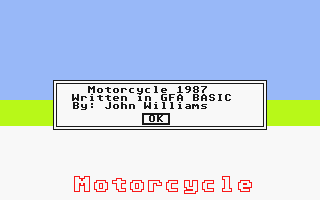
Motorcycle
- Genre
- Racing - Motorcycle
- Year
- 1987
- Language
- GFA BASIC
- Publisher
- [no publisher]
- Controls
- Mouse
- Distributor
- —
- Players
- 1
- Developer
- [n/a]
- Resolution
- Low
- Licensed from
- —
- Programmer(s)
- Williams, John
- Country

- Graphic Artist(s)
- Williams, John
- Software
- English
- Game design
- Williams, John
- Box/Instructions
- English
- Musician(s)
- [n/a]
- License
- PD / Freeware / Shareware
- Sound FX
- Williams, John
- Serial
- —
- Cover Artist(s)
- —
- ST Type
- ST, STe / 0.5MB
- MIDI
- —
- Version
- —
- Dump
- Download
- Number of Disks
- 1 / Double Sided
- Dump format
- ST
- Protection
- —
INSTRUCTIONS
Hi, and welcome to MOTOR, the motorcycle simulation. By now,
you've unpacked the files, one of which you're looking at now. You
should have four files:

MOTOR.PRG - The program.
MOTOR.PI1 - The sprite picture file.
MOTOR.TXT - The course data file.
MOTOR.DOC - This file.

The reason why I call this program a simulator is because there
is no goal, no score. The object is to control the motorcycle
through courses you create. An easy course is provided in order
for you to become acquainted with MOTOR.

THE DISPLAY:

There are four objects of interest in the MOTOR display, the road,
the motorcycle, the warning sign, and the speedometer. As you
drive through the course, the road will twist and turn. You must
control the bike to stay on it. The speedometer indicates how fast
you are going, and the engine sound will change pitch to
correspond to your speed. The warning sign will show you when the
course is changing.

THE CONTROLS:

The mouse controls the motorcycle. Sideways movements of the mouse
control banking. All turning is accomplished through banking the
motorcycle. The mouse position determines the rate at which the
motorcycle will bank. The speed of the bike determines how tightly
you can turn given a certain bank. The faster you travel, the less
effect banking will have on turning.

The right button is the throttle, and the left button is the
brake. Press the right button to speed up, and the left to slow
down.

THE COURSE FILE:

The course file contains a script describing the road. Each line
has three numbers:
N,Turn,Distance

N is the next step. The course begins at step 0 and follows the
steps according to the value N for that step. Typically, the N for
successive steps increments on each step, until the last step. The
last step has an N value of 0, directing back to the beginning of
the course.

Turn is the degree of turn. This number must be an integer between
0 and 63. 31 is a straightaway.

Distance is the distance of the step, that is, how far the
motorcycle must travel to get to the next step.

MOTOR automatically triangulates the course. The actual turn of
the road is determined by weighted a average of the turn and the
next turn according to how far you travelled into that step.
The simple course included illustrates this principle:

1,31,3000
2,31,5000
3,0,1000
4,0,5000
5,31,3000
6,31,5000
7,63,1000
0,63,5000

The road will:
Go straight 3000 units
Ease into a hard right turn over 5000 units
Hard right turn 1000 units
Ease into a straightaway over 5000 units
ETC., until the last step, where it loops back to the beginning,
Easing into a straightaway over 5000 units.

A little experimentation on turns and distances will result in a
course that is fairly difficult, yet gives adequate warning of
impending turns. You are allowed to have 100 steps in a course.
You must create a loop starting from step 0. The provided course
should be fairly challenging for a while, and by the time you want
to design your own course, you will understand the concepts a
little better.

HINTS ON PLAY

1) Going straight can be difficult. This is because after you have
stopped moving to the side, you are usually in a bank that will
tend to accelerate you in the opposite direction. If you are not
careful, this can result in oscillations that will eventually
drive you off the road. When stopping a sideways movement, ease
out of the bank slightly prior to having come to a proper
direction. Pull out of the bank immediately before the motorcycle
ceases to move sideways. Most straightaways are long enough that
you will never have to go into a hard bank to move a little to the
side. On the straightaways, be gentle with the controls.

2) On turns, you can use the throttle and brake to control
sideways movement. Slow down to make a tighter turn, speed up to
take a wider turn. Going into a turn, bank the bike as far as it
will go, and slow down to stay on the road. Coming out of a turn,
speed up and gently ease out of the bank.

3) On long straightaways, watch your speed. The turns can come
very quickly at high speed, forcing you off the road before you
have a chance to slow down. On the other hand, the faster you go
on straightaways, the easier the bike will be to control.

4) If you crash, you will hear a clunking sound, and see an alert
box, use this opportunity to straighten the mouse position.

5) Oh, yeah, you have unlimited fuel, unlimited lives, and
unlimited time.

6) The OBJECT of this game is CONTROL. Good luck!