Racing / Racing - Cars · 2021
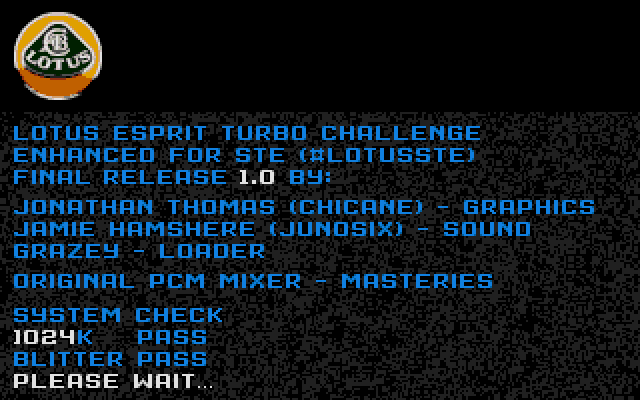
Lotus Esprit Turbo Challenge STe
Published by [no publisher] · Developed by [n/a]
atarimania.com — atari-st-games-lotus-esprit-turbo-challenge-ste-37660
Information
- Genre
- Racing - Cars
- Language
- Machine Language
- Controls
- Joystick
- Players
- 1, 1 vs. 2
- Resolution
- Low
- Programmer(s)
- Southern, Shaun, Thomas, Jonathan, Hamshere, Jamie
- Graphic Artist(s)
- Morris, Andrew, Thomas, Jonathan
- Game design
- Morris, Andrew, Southern, Shaun
- Musician(s)
- Daglish, Ben
- Sound FX
- Hamshere, Jamie
- Year
- 2021
- Publisher
- [no publisher]
- Developer
- [n/a]
- Software
- English
- Box/Instructions
- English
- License
- Hack
- ST Type
- ST, STe Enhanced, 1MB
- Version
- 1.0
- Number of Disks
- 1, Double Sided
Votes / Statistics
Rating: 10.0/10 · Votes: 1 · Downloads: 4,673 · Hits: 41,197
Screenshots (16)


Trivia (4)
Origins
How did Lotus STE come about, and how has it evolved over time?
--------------------------------------------------------------------------
--------------------------------------------------------------------------
Jonathan has always been a fan of the Lotus games, with Lotus 1 always being his favourite in the series despite the technical advances of the later games. He owned and played the game on his Atari ST back in 1990, but it was only recently that he discovered the dramatic difference in quality between the ST and Amiga versions.
Like many people, Jonathan was disappointed with the uptake of the STE hardware by software publishers back in the 1990s, and wondered in the late stages of 2019 if Lotus might be improved through use of the STE hardware. He used the experience gained during his previous project (Atari STE Pole Position) to prototype a few modifications to the game, but encountered technical challenges working with the STE hardware and shelved the project on the assumption that it was not workable.
Many discoveries were made by the Atari community regarding best use of the STE hardware (and particularly the Blitter) during the course of 2020, and Jonathan picked up the project again in late 2020 with a fresh set of ideas. The code was reworked to overcome the previous challenges, and the community at Atari-Forum showed enthusiasm for the project. Masteries at Atari-Forum provided software to play multiple channels of audio on the STE's DMA hardware, and Junosix built upon this work, adding variable rate playback code to support a sampled engine sound. The pace of the project has picked up massively since Junosix joined the project, with daily improvements to the sound side of things being contributed by Junosix, and Jonathan replacing existing graphics routines to make use of the Blitter. Following this period of hard graft, we've arrived at a point where we feel that we have a initial feature set that we can release to the public!
Steve is the owner of the AtariCrypt website, and has been chronicling recent updates to the code with a series of articles and videos. He also covers a wide range of other Atari ST games and productivity software on this website!
Hardware
Supports Blitter
Supports STe DMA sound
Supports STe palette
Supports STe hardware scrolling
Supports STe DMA sound
Supports STe palette
Supports STe hardware scrolling
Requires Blitter on ST
Sound
Features digitized sound fx at 12.5KHz
Graphics
Features up to 42 colours on-screen simultaneously (in-game) on STe
Features up to 31 colours on-screen simultaneously (in-game) on ST
Features up to 31 colours on-screen simultaneously (in-game) on ST
Comments (6)
Bob from Soiree Games — 20 Apr 2021
Wonderful!
Wasabim — 11 Apr 2021
Thank you for this adaptation !
RetroBoxRoom — 11 Apr 2021
Amazing, just amazing! Thank you for all the hard work!
IntoTheVerticalBlank — 11 Apr 2021
Now my favorite all time ST racing game
AtariCrypt — 10 Apr 2021
Transformed an already-excellent game into something special for the Atari STe. These guys should be very proud. Well done Jon/all.!!!
Fatberg — 10 Apr 2021
A great upgrade of a classic game :)