

Atari ST - ?
Cribbage
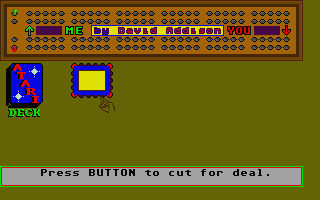
- Genre
- Cards - Miscellaneous
- Year
- —
- Language
- GFA BASIC
- Publisher
- [no publisher]
- Controls
- Mouse
- Distributor
- —
- Players
- 1
- Developer
- [n/a]
- Resolution
- Low
- Licensed from
- —
- Programmer(s)
- Addison, David
- Country

- Graphic Artist(s)
- Addison, David
- Software
- English
- Game design
- Addison, David
- Box/Instructions
- English
- Musician(s)
- [unknown]
- License
- PD / Freeware / Shareware
- Sound FX
- Addison, David
- Serial
- —
- Cover Artist(s)
- —
- ST Type
- ST, STe / 0.5MB
- MIDI
- —
- Version
- —
- Dump
- Download
- Number of Disks
- 1 / Double Sided
- Dump format
- MSA
- Protection
- —
INSTRUCTIONS
The Rules of Cribbage

Cribbage is a two player card game.   The players take turns being
the dealer.   Cards are valued as follows:  ace is worth 1, number
cards  are  worth their face value,  and tens and face  cards  are
worth 10.

The Deal

When  the game begins,  the dealer first deals six cards  to  both
players.   Then  each player selects two cards from his/her  hand,
and  places them face down in a pile called the crib.   After  the
crib is formed, the dealer cuts the rest of the pack, and turns up
the  top  card  of the lower portion.   This card  is  called  the
starter.   If the starter is a jack,  the dealer scores two points
"for his heels".

Play

After the deal is finished and the crib is formed, and the starter
is  turned  up players alternately play one card,  with  the  non-
dealer  playing  first.   This continues until  a  player,  during
his/her  turn either cannot play without making the total  of  the
played cards greater than 31 or is simply out of cards.

At this point,  if the player is not out of cards the player  must
say  "go",  and the player's opponent scores 1.   After the go  is
called,  the  player  who said "go" leads for  another  series  of
plays.   The count starts at zero again,  and as always, the total
of the played cards cannot exceed 31.


When  a player says "go",  that player's opponent must play  until
he/she  is out of cards,  or has no card that would not  make  the
total  of the played cards greater than  31.   Consequently,  this
player could play more than one card.

If  a player cannot play because he/she has no  cards,  the  other
player  plays out his/her hand,  but is not given  any  additional
score.   As the player plays out his/her hand, if the total of the
played cards would exceed 31,  the played cards are moved away and
the count starts at zero again.


Scoring

Scoring  is  done  during play (see Scoring  In  Play),  and  also
immediately after play ceases (see Showing).


Scoring In Play

When a player says "go", the other player scores 1.

31

A  player scores 2 for bringing the total of the played  cards  to
exactly 31.

Last Card

A player receives 1 for playing the last card, or 2 if this brings
the total of played cards to exactly 31.

15s

A player receives 2 for bringing the total of the played cards  to
exactly 15.

Pairs

If  a  player  plays a card of the same rank as  the  card  played
immediately before (i.e.  if the player forms a pair),  the player
scores 2.   If the player plays a card of rank equal to the  ranks
of the previously played 2 cards,  he/she scores 6.  If the player
plays a card of rank equal to the ranks of the previously played 3
cards,  the player receives a score of 12.  (Note that rank should
not  be confused with value:  10 and King are of equal  value  but
different ranks).


Runs

If  a player plays a card that results in a run of length  greater
than 2,  the player receives a score equal to the number of  cards
in the run.   The cards in the run need not be ordered,  but there
may  not  be any "foreign" cards in the middle of  the  run.   For
example, the player scores 3 for the following:

A 3 5 7 6 (5, 7, & 6 form a 3-run)

And the following is not a run:

5 J 6 7 (the Jack is foreign, so the 5, 6, & 7 do not form a run)

Showing

After  play is complete,  each player turns all of  his/her  cards
face up, the crib is turned up, and additional scoring is done for
each player.   This process is called "showing".   Cards are shown
in the following order: non-dealer's hand, dealer's hand, and crib
(which  belongs to the dealer).   For each  hand  (dealer's,  non-
dealer's,  and crib) the starter forms a fifth card).   The dealer
receives the score for the crib.

15

Each combination of 15 scores 2 points.  For example:

Player's Hand       Starter

A 7 8 3             7

The  player in the above example has 2 fifteens:

1:   7 & 8 both from player's hand
2:   8 from player's hand and 7 (starter)

For the two fifteens, the player scores 4.

Pairs

A player scores 2 for each pair,  6 for each 3 of a kind,  and  12
for each 4 of a kind.  For example:

Player's Hand       Starter

4 5 5 5             3

In  the above example,  the player receives 6 for the 3 of a  kind
(i.e.  the 3 5's).  The player does not have any pairs (the 3 of a
kind  cannot be split to form pairs).   If the player had 4  of  a
kind, it could not be split either.


Runs

For each combination that a player has that forms a run of  length
3 or more, the player scores the length of the run.  For example:

Player's Hand       Starter

A 2 3 7             2

In the above example, the player has two 3-runs:

1:   A 2 3   (all cards from player's hand)
2:   A 2 3   (using the starter)

The player then receives 6:  3 for either 3-run.

Flush

If  the player has 4 cards of the same suit in his/her  hand  (not
including the crib and starter),  the player receives 4.   If  the
starter is also of the same suit,  the player receives 5.   If the
crib and starter are all of the same suit, the player receives 5.

His Nobs

If  a  player has a jack with the same suit as  the  starter,  the
player scores 1 for "his nobs".

Game Length

The  game can be played "once around" or "twice around."   If  the
game  is  played  once around,  play continues  until  one  player
achieves  a  score of 61 or more.   If the game  is  played  twice
around (as is most often the case), play ceases when a player gets
a score of 121 or greater.

Lurch

If  the game is played once around and the loser receives a  score
less than 31, that player is "lurched", and the winner receives an
additional game score.  If the game is played twice around and the
loser  receives  a  score less than 61,  the winner  is  given  an
additional game score for the lurch.


Additional Information about Cribbage

The following texts will provide additional information about  the
strategy of Cribbage:

Hoyle's Modern Encyclopedia of Card Games (Highly Recommended)
Walter B. Gibson
Dolphin Books, Doubleday and Co., Inc., Garden City, New York
ISBN 0-385-07680-0

Hoyle's Rules of Games, Second Revised Edition
Albert H. Morehead and Geoffrey Mott-Smith
Signet New American Library, NAL Penguin, Inc., New York
ISBN 0-451-14842-8
TRIVIA (1)
Releases
First 16-bit releases reviewed in UK Atari or multiformat magazines for Atari ST (12/1989)
BOOK / MAGAZINE REVIEWS (1)
ST Format · January, 1990Rating: 2/5